Post-crash response is a broad and complex topic area within the Safe System. Activity in this area is often the role of highly specialist practitioners but there is a role for everyone to play. Because a lot of the content in this area is quite technical and specialist, we have included summary information on the more complex topics to provide an introduction. Additional detail is then available for those who have a more technical interest.
The post-crash response content is split into five sections which cover the topic in-depth. You can jump straight to the in-depth content using the links below, or continue on this page for a summary of each.
Content Summary
Post-crash response starts with what happens immediately after a crash but also includes the many years of rehabilitation and support victims and their families may need, and how we learn from crashes that have happened. The content is split across the following sections and each is summarised below:
Background
Injuries from road crashes are the main concern of post-collision response systems. To understand how to prevent injury, improve care and reduce harm, we first need to understand what injury is, how it happens, and why it affects people differently.
An injury is damage to the body caused by an outside physical force. In road crashes, these forces will come from sudden deceleration, impacts, compression, or shearing forces. These forces act on a moving body when that motion is suddenly changed.
To understand injury, we need to learn about:
Biomechanics – how energy is absorbed, dissipated, or transmitted through the body
Kinematics – how things (like people or vehicles) move, without reference to the forces causing the movement
Individual differences – how age, health, and body type affect a person’s response to injury
The mass, speed and direction of each vehicle will determine the energy involved. When a crash happens, this energy from the moving vehicle(s) must be absorbed or transferred. If the energy transferred to a person is too much for the body to handle (called tissue tolerance), an injury occurs.
Modern vehicles have safety systems like seatbelts, airbags, crumple zones, reinforced cabins, and advanced sensor-driven restraint systems. These systems protect people, but they aren't perfect. For example, seatbelts may reduce fatal injuries but can cause chest injuries in older adults or abdominal injuries in children.
People’s response to injury also varies. A healthy, young adult might survive a high-speed crash with minor injuries. But an older person could die from a low-speed crash because of weaker bones or medical conditions like osteoporosis.
In post-crash care, professionals must quickly:
Understand what happened (the kinematics)
Know how safety systems worked (or failed)
Consider the person’s ability to handle injury (their tissue tolerance)
By understanding these three parts, we can better interpret the scene, predict injuries, make faster decisions, and provide better treatment.
This knowledge is not just for doctors. It also affects:
Car design
Emergency response
Road planning
Public education
Understanding injury is at the heart of every aspect of a Safe System.
Kinematics and Energy Transfer
Kinematics describes how objects move without considering the forces that cause them. In road safety this is about how people or vehicles move before, during, and after a crash.
The energy in a crash can be calculated using this formula:
E = 0.5 × m × v²
Where:
E is energy
m is mass
v is velocity (speed)
This shows why a small increase in speed leads to a big increase in energy.
In a crash, this energy must go somewhere. Ideally, most is absorbed by the vehicle’s safety systems. But some energy still reaches the people inside. If this energy is higher than each person’s tissue tolerance, injuries happen.
Examples:
Older adults are more likely to break ribs from seatbelts.
Children can be hurt by seatbelts that don’t fit properly.
Mechanisms of Injury
In a crash, injury often happens in three stages:
Vehicle deceleration – Energy is absorbed by crumple zones or deformation.
Occupant deceleration – Seatbelts or airbags stop them.
Internal impact – Organs inside the body hit the skeletal structure, for example, the brain hits the skull, or tear due to deceleration, rotation or shearing forces.
These forces are often both linear (straight) and rotational (turning), contributing to injury complexity.
Tissue Tolerance and Individual Differences
People’s bodies respond differently to injury. Factors include:
Age – Older adults have weaker bones and slower recovery.
Sex – Body shape and hormones may change injury risks.
Health – Conditions like osteoporosis or heart disease affect survival and recovery.
This is why injury patterns are not the same for everyone. For example, older drivers may die from low-speed crashes that younger, healthier people would survive.
The Injury Equation
We can think about injury like this:
Injury happens when:
(Crash forces) – (Protection from safety systems) > (Tissue tolerance)
In other words, if the force from the crash is stronger than the body can handle, injury happens. The bigger the gap, the worse the injury is likely to be.
When People Die After Injury
When death occurs after injury has historically been described in three phases (trimodal distribution):
Immediate deaths at the scene (e.g., major brain or vascular injury).
Early deaths (within hours) due to treatable conditions like haemorrhage.
Late deaths (days to weeks) from organ failure or sepsis.
However, in mature trauma systems more recent evidence suggests a bimodal distribution (two peaks), as better early care has reduced late deaths. Emerging work suggests a quadrimodal model, which adds a fourth peak:
Post-discharge deaths, particularly in older or critically injured patients who succumb to complications after leaving hospital.
Implications for Delivery
Transport professionals play a crucial role in injury prevention and early response. A basic understanding of how injuries happen helps improve scene safety, triage, and collaboration with emergency responders.
Key points:
The scene: Recognising high-energy mechanisms (e.g., high-speed rollover, intrusion into the passenger cabin) can help anticipate injury severity.
Communication with responders: Clear descriptions of injuries and vehicle damage helps emergency teams.
Infrastructure planning: Knowing how injuries happen supports road design and policy decisions that help reduce the energy involved (e.g., speed limits, crash barriers).
Design for all: Understanding differences in tissue tolerance helps design safety systems for everyone, ensuring protection across age, size, and ability.
In short, reducing deaths from road crashes means combining knowledge of:
How people and vehicles move (kinematics)
How safety features perform
How different people respond to injury
By understanding these, transport professionals help create a Safe System for all.
Please see the Introduction to Injury and Death in Road Crashes section for more detail.
Background
Even though roads and vehicles are safer today, millions of people still die or are badly hurt in crashes. Many of these lives could be saved with better care after the crash.
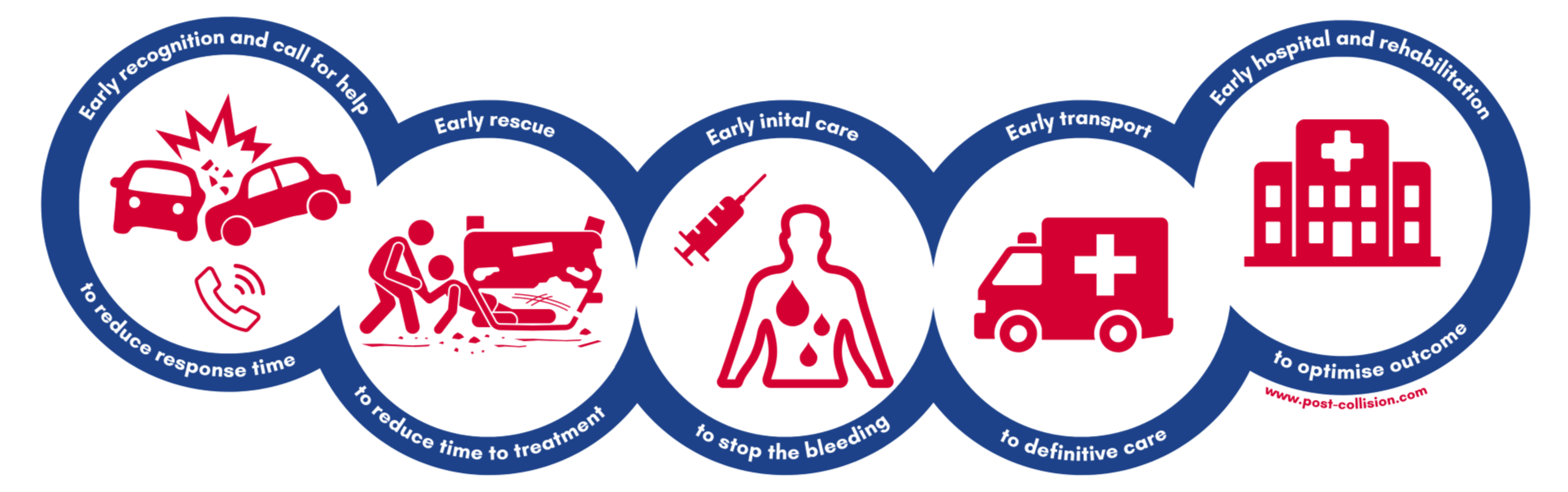
To help improve survival, experts created a new idea called the Road Injury Chain of Survival. This idea comes from the way we treat heart attacks or cardiac arrest, where fast action saves lives.
This chain has five important steps that must happen in order:
Early recognition and call for help
Early rescue
Early initial care
Early transport
Early hospital care and rehabilitation
Each step helps reduce harm and improve the chance of survival and recovery.
What the Research Shows
1. Early Recognition and Call for Help
Noticing that someone is seriously hurt and calling for help quickly is the first and most important step. In rich countries, crash alerts can be sent automatically by cars. In other places, we rely on bystanders to call for help.
If help is delayed—especially in the countryside—outcomes are often worse.
Some tools, like the sBATT score, can help bystanders spot serious injuries and respond quickly.
2. Early Rescue
Being trapped in a car can delay treatment. The longer the delay, the worse the outcome. Recent studies show that getting someone out quickly (if it’s safe) is more important than moving them gently but slowly.
3. Early Initial Care
Bystanders or first responders can give life-saving help before the ambulance arrives. Simple actions like:
Pressing on bleeding wounds
Opening someone’s airway
Placing them in the right position
May save lives.
Training programs like Stop the Bleed show that regular people can learn these skills.
In some places, giving a shot of tranexamic acid (TXA) can help stop bleeding, especially where IV access is hard.
4. Early Transport
Getting to hospital fast is key. Research shows that shorter prehospital times lead to better outcomes.
In some areas, there are no ambulances or roads are bad, so people may use any transport they can find. In those cases, the benefits of moving the patient quickly are often greater than the risks.
We now know spinal injuries are less common than we once thought and movement is usually safe if done carefully.
5. Early Hospital Care and Rehab
Once in hospital, patients need emergency care—like surgery or intensive care. How fast they get treated and how well services work together matters a lot.
Rehab should start early. This helps patients recover and live better lives after injury.
Why the Chain Matters
The Road Injury Chain of Survival is not just for medics—it helps everyone plan better care systems. It supports:
Better data at each stage, so we can learn and improve
Spotting weak links in the system
Smart investment in training, tools, and people
Fair comparisons between countries or regions
It can be used around the world—whether in cities with helicopters or small villages with no ambulance.
Implications for Delivery
Training: Everyone—bystanders, emergency crews, planners—should know their role in the chain.
Planning: The chain helps planners predict needs and fix problems.
Policy and funding: Governments can use the chain to decide where to spend money.
Data and quality: The chain offers clear points to collect data and check how things are going.
Works anywhere: It’s a flexible tool for all kinds of places—from cities to rural communities.
By using this chain, road safety systems can go from being random and patchy to organised and life-saving.
Please see the Road Injury Chain of Survival section for more detail
Background
After a crash, what happens in the first few minutes can make a big difference. In many places—especially in the countryside—the first people on the scene are not emergency crews. They are bystanders: people who just happen to be there.
Bystanders can be:
Untrained – everyday people like drivers, walkers, or passers-by.
Community First Responders (CFRs) – trained volunteers who are often nearby and ready to help.
Professional bystanders – police or fire crews who arrive first but aren’t medics.
Each group can help in different ways. If they are trained, supported, and given the right tools, bystanders can save lives and reduce injuries. This can be done without spending a lot of money.
To guide this, experts created the Bystander Wheel—a tool that shows six ways bystanders can help. We’ll look at this in detail in later lessons.
What the Research Shows
Lots of research proves that bystanders are important in the time between the crash and the arrival of medical help.
Studies from Australia and the UK show that bystanders are present at over half of crashes. But fewer than half actually try to help.
Simple actions—like stopping bleeding or helping someone breathe—can prevent some deaths. One study said about 1 in 20 deaths could be stopped by basic first aid.
People who have first aid training are:
More likely to help
More likely to do the right thing
More confident
The most common actions by bystanders are:
Changing the person’s position to help breathing
Opening their airway
Giving comfort and support
In some places, police and fire crews often arrive before medical teams. These professional bystanders know how to work in emergencies. With some extra training, they can fill the early care gap. But there can be problems—like not knowing if it’s part of their job or worrying about being blamed if something goes wrong.
Bystanders often fear:
Making things worse
Getting in trouble legally
Not knowing what to do
But with training, support, and clear rules, these fears can be reduced.
Follow-up and thanks also matter. People who feel supported are more likely to help again in future.
Countries with strong community response systems—like trained volunteers and call centre support—see better bystander action and better crash outcomes. This is very helpful in rural areas where ambulances take longer to arrive.
Implications for Delivery
To make the most of bystanders:
Define their roles: Know the difference between untrained, trained, and professional bystanders. Teach each group what they can do.
Include them in the system: Emergency systems should guide bystanders using phone instructions and give support after the event.
Teach key skills: Everyone should learn basic care like opening airways, stopping bleeding, and giving comfort. Add this to driver training and jobs like police or fire service.
Support mental health and legal worries: First aid classes should talk about safety, legal protection, and how to deal with the stress of helping.
Use the community: Helping communities respond is low-cost and effective. It should be part of every road safety plan.
Plan using the Bystander Wheel: This tool helps decide what to teach, what to give people, and how to measure success.
Please see the Bystander Care section for more detail.
Background
Effective road collision investigation and learning practices are vital for reducing deaths and serious injuries. However, traditional investigations often focus narrowly on immediate causes, such as driver behaviour, and as a result neglect deeper, systemic failures like poor road design or policy gaps.
Also, the broad definition of serious injury has been a barrier to understanding which crashes cause more severe injuries and deaths, which are the focus in a Safe System. New data collection methods using injury-based reporting now include three levels of serious injury - very serious, moderately serious and less serious - and the most serious injury suffered. A list of the injuries and how they map to different severities is shown below:
Injury | Detailed severity | Severity classification |
Deceased | Killed | Killed |
Broken neck or back | Very Serious | Serious |
Severe head injury, unconscious | Very Serious | Serious |
Severe chest injury, any difficulty breathing | Very Serious | Serious |
Internal injuries | Very Serious | Serious |
Multiple severe injuries, unconscious | Very Serious | Serious |
Loss of arm or leg (or part) | Moderately Serious | Serious |
Fractured pelvis or upper leg | Moderately Serious | Serious |
Other chest injury (not bruising) | Moderately Serious | Serious |
Deep penetrating wound | Moderately Serious | Serious |
Multiple severe injuries, conscious | Moderately Serious | Serious |
Fractured lower leg or ankle or foot | Less Serious | Serious |
Fractured arm or collarbone or hand | Less Serious | Serious |
Deep cuts or lacerations | Less Serious | Serious |
Other head injury | Less Serious | Serious |
Whiplash or neck pain | Slight | Slight |
Shallow cuts or lacerations or abrasions | Slight | Slight |
Sprains and strains | Slight | Slight |
Bruising | Slight | Slight |
Shock | Slight | Slight |
Introduction of the new reporting methods means historical data is adjusted nationally to enable like-for-like comparison.
In Scotland, all fatal road traffic collisions are reported to the Scottish Fatalities Investigation Unit (SFIU) in the Crown Office and Procurator Fiscal Service (COPFS). COPFS investigates all sudden, suspicious, accidental and unexplained deaths and decides if a prosecution and/or Fatal Accident Inquiry is required in relation to the death(s). Fatal Accident Inquiries (FAIs) provide valuable public insight into crash causes and should be more systematically used by road safety professionals.
What the Research Shows
Thematic investigations using systems-based tools like AcciMap and STAMP-CAST can reveal recurring patterns and inform better infrastructure, vehicle design, and policy decisions. These types of investigation are used within other transport modes by the respective investigation branches and have underpinned recommendations for a UK Road Safety Investigation Branch.
Research also shows that improved information and knowledge sharing provides better learning and intervention opportunities.
Implications for Delivery
Greater collaboration between police, analysts, policy advisors, and Safe System experts would enhance learning outcomes.
Partnering with police and researchers to explore high-risk crash types or locations offers deeper understanding and more effective intervention.
Injury-based reporting further enhances our understanding of serious injury, but accurate data interpretation and consistent use of adjusted vs. non-adjusted figures are essential for informed decision-making.
Sharing findings publicly, standardising approaches, and promoting cross-regional learning help prevent repeat incidents and build a safer transport system overall.
Please see the Investigation and Learning section for more detail.
Background
Victim support is a vital part of responding to fatal and catastrophic road collisions. In Scotland alone, 160 people were killed and 1,931 seriously injured in 2024. These events have life-altering consequences not only for the victims but also for their families, friends, and wider communities. People affected often face immediate and complex needs—ranging from navigating unfamiliar legal and medical processes to dealing with grief, trauma, or life-changing injuries. Many victims experience significant mental health impacts, which can worsen without timely emotional support.
What the Research Shows
Research has shown that road victims value specialist, ongoing support delivered with empathy and compassion. Services like the National Road Victim Service—funded by the Scottish Government—provide practical and emotional help through dedicated caseworkers. Victims say having someone to ‘walk beside’ them during the weeks and months after a crash can be life-changing, helping them cope, regain emotional strength, and feel understood. Importantly, police officers play a key role in connecting victims with support services, reducing the burden on families during traumatic times. Ensuring access to high-quality, timely support is essential to helping people recover from the devastating effects of road trauma.
Implications for Delivery
Victim needs are immediate and long-term: People affected by road trauma—whether bereaved or seriously injured—require both practical and emotional support from the outset. This includes help navigating legal, medical, and funeral processes, often in unfamiliar and overwhelming circumstances.
Specialist support is essential: Services like the National Road Victim Service provide dedicated caseworkers who offer tailored, compassionate assistance. This one-to-one support over time has been shown to help victims cope and recover more effectively.
Trauma and mental health support must be prioritised: Many victims experience trauma symptoms, even if not directly involved in the crash. Without early intervention, these can develop into serious mental health conditions. Emotional support is therefore as important as practical help.
Police referrals reduce barriers: Victims are more likely to access support if they are directly referred by police officers, reducing anxiety and ensuring early connection to services.
Support should be flexible and victim-led: Research highlights the importance of letting victims decide when and how to engage with support. Practitioners should adopt an empathetic, trauma-informed approach that respects individual coping processes.
Please see the Victim Support section for more detail.
With thanks to IMPACT - The Centre for Post-Collision Research, Innovation and Translation and Brake - the road safety charity for their contribution to this content.