Implications for Delivery
Adopting Vision Zero and the Safety System approach challenges existing thinking. People involved in road safety need to consider how these principles might change the way they work:
Road traffic deaths can be prevented, they are not just something we have to accept.
People make mistakes, they are not perfect.
We should focus on stopping the most serious crashes, not every single crash.
Everyone shares responsibility for road safety – not just individual road users.
Saving lives doesn't have to cost a lot – it's more affordable than many think.
Take some time to explore this manual and the topics important to your role to find out more.
Background
Roads, and the way they have connected people and places, have shaped the way we now live and brought lots of benefits. But this has also come at a cost.
In 1896, Bridget Driscoll was the first person killed by a car in the UK as she walked across the road in Crystal Palace, London. At the time, the coroner is reported to have said, “I hope such a thing will never happen again.”
Sadly, Bridget Driscoll was the first of many and now, almost 130 years after that first road death, more than 500,000 people have died on the roads in the UK. Globally, the World Health Organisation estimated there were 1.19 million road deaths in 2021 – 15 deaths per 100,000 people. This makes road traffic the leading cause of accidental death worldwide and the leading cause of death for people aged 5 to 29. A further 20 to 50 million people around the world each year suffer serious injuries.
In Scotland 161 people died in road crashes in 2024 and 1,978 people were seriously injured. In the last 10 years, nearly 25,000 people have died or been seriously injured on Scotland’s roads. This is why we must act.
Road crashes also cost a lot of money. In 2024 crashes in Scotland were estimated to cost £1.27bn.
But it doesn’t have to be like this. Injury and death on our roads can be prevented, and mistakes on the road don’t have to result in death or serious injury. This is the thinking that is behind the Safe System approach, also known as Vision Zero. First introduced in the 1990s, Vision Zero challenges traditional views by saying:
Road traffic deaths can be prevented, they are not just something we have to accept.
People make mistakes, they are not perfect.
We should focus on stopping the most serious crashes, not every single crash.
Everyone shares responsibility for road safety – not just individual road users.
Saving lives doesn't have to cost a lot – it's more affordable than many think.
This change in approach has seen big changes in the way road safety is managed and delivered in countries like Sweden, the Netherlands and Norway. The approach is focused on what can cause serious injury and death and how different parts of the road system can add layers of protection to prevent them. The diagram below shows each part and there are sections in this guide on each.
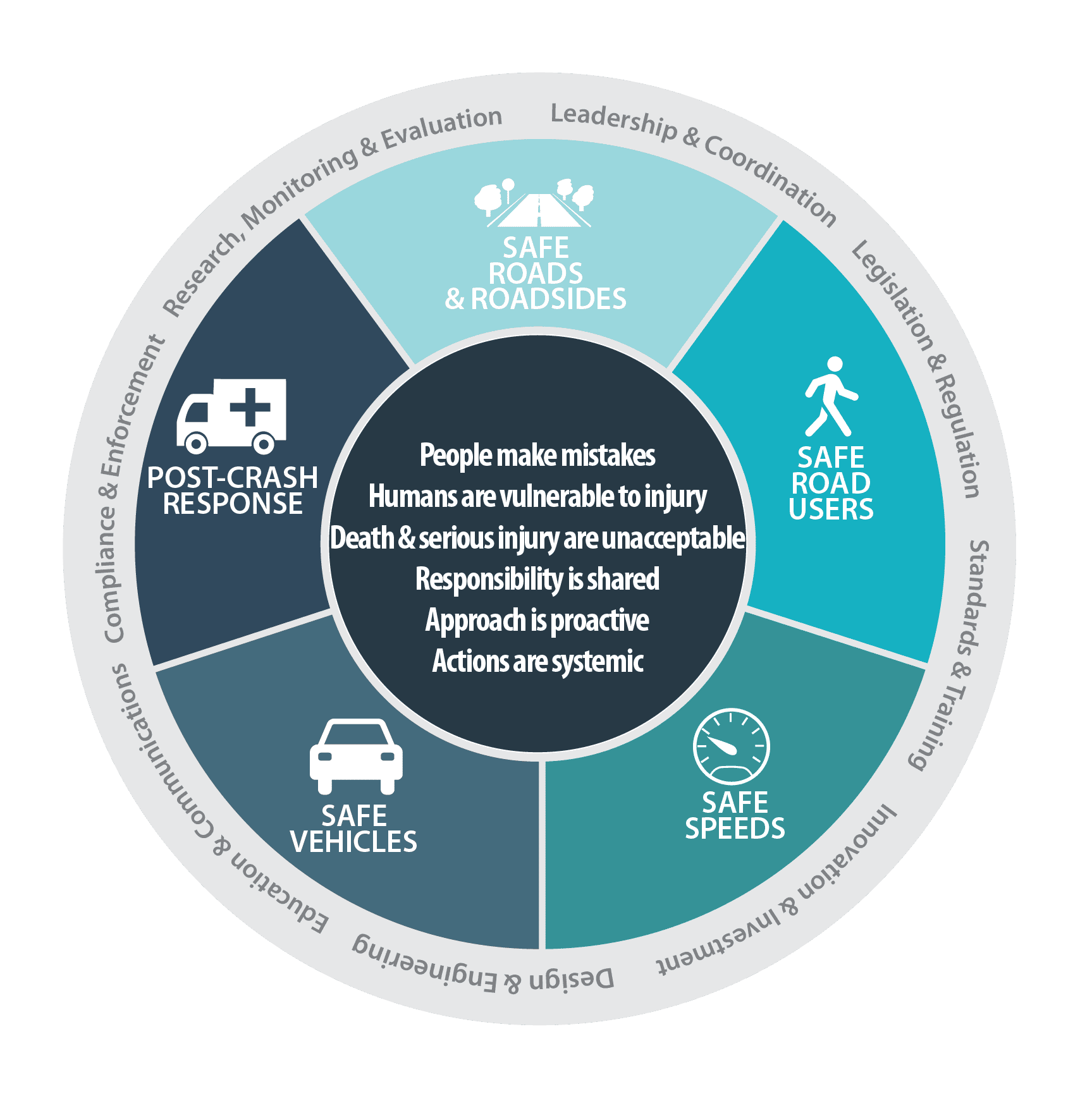
Safe System diagram (Agilysis, 2022)
In 2021, the Scottish Government published Scotland’s Road Safety Framework to 2030 based on Vision Zero. This framework aims for Scotland to have the safest roads in the world by 2030 and set a long term goal of zero fatalities and serious injuries by 2050.
This manual aims to provide a framework for practitioners in Scotland to adopt Vision Zero and Safe System principles into their work. It will explain why each part of the system is important, what the evidence says, how this can be used in Scotland, who else to work with, and where you can find more information.
What the Research Shows
Norway has been one of the best performing countries in reducing road casualties since 2000, when it adopted Vision Zero. Importantly, Norway has continued to see progress when other countries have stalled over the last decade. Research has shown that Vision Zero influenced the road safety policies in Norway, particularly setting road safety targets and performance indicators. These have led to a new speed limit policy, improvements to guardrails and the conversion of many routes to motorways or 2+1 roads. It is not possible to say the exact effect of adopting Vision Zero in Norway, but the change in progress since its adoption is clear.
Sources
Edvardsson Björnberg, K., Hansson, S. O., Belin, M.-Å., & Tingvall, C. (Eds.). (2023). The Vision Zero Handbook: Theory, Technology and Management for a Zero Casualty Policy. Springer. https://doi.org/10.1007/978-3-030-76505-7
Elvik, R. (2023). Vision Zero in Norway. In K. Edvardsson Björnberg, S. O. Hansson, M.-Å. Belin, & C. Tingvall (Eds.), The Vision Zero Handbook: Theory, Technology and Management for a Zero Casualty Policy (pp. 295–306). Springer. https://doi.org/10.1007/978-3-030-76505-7_10
Parliamentary Advisory Council for Transport Safety (PACTS). (n.d.). Safe System. https://www.pacts.org.uk/safe-system/
Transport Scotland. (2021). Scotland’s Road Safety Framework to 2030. https://www.transport.gov.scot/news/scotland-s-road-safety-framework-to-2030/
Transport Scotland. (2024). Reported road casualties Scotland 2023. https://www.transport.gov.scot/publication/reported-road-casualties-scotland-2023/
Vision Zero Network. (n.d.). What is Vision Zero? https://visionzeronetwork.org/about/what-is-vision-zero/
World Health Organization. (2009). Global status report on road safety: Time for action (ISBN 9789241563840). https://www.who.int/publications/i/item/9789241563840
World Health Organization. (2023). Global status report on road safety 2023. https://www.who.int/teams/social-determinants-of-health/safety-and-mobility/global-status-report-on-road-safety-2023