Implications for Delivery
Organisational Change Saves Lives: Centralised trauma networks improve survival not primarily by introducing new treatments, but by reorganising care pathways. Transporting severely injured patients to specialist centres with appropriate capabilities is crucial.
Bypass Protocols Are Safe and Effective: The triage and bypass systems that allow paramedics to take patients directly to Major Trauma Centres (MTCs) have been shown to be safe, provided good triage tools and protocols are in place.
Rural Access Must Be Considered: Rurality remains a challenge. In areas with long travel times to MTCs, trauma units must stabilise patients effectively and ensure timely secondary transfer. Helicopter emergency medical services (HEMS) and enhanced coordination play key roles in mitigating geographic inequality.
Standardised Data and Continuous Audit Are Vital: The success of trauma networks has been underpinned by data collection and audit via the Trauma Audit and Research Network (TARN). Regular review of performance indicators enables iterative improvement and accountability.
Networks Must Remain Adaptive: As populations age and the pattern of injury changes (e.g., more low-energy falls in older adults), trauma systems must evolve. There is also increasing recognition of the importance of post-acute rehabilitation and long-term outcomes in trauma care.
Background
Trauma is a leading cause of death and disability, especially among younger people. Historically in the UK, trauma care was fragmented - patients were taken to the nearest hospital regardless of its capabilities, leading to inconsistent outcomes. A series of national reviews, including the 2007 “Trauma: Who Cares?” NCEPOD report, highlighted significant deficiencies in trauma care, prompting calls for reform.
In response, regional trauma networks were introduced between 2010 and 2012. These networks aimed to standardise trauma care, concentrating resources and expertise into a structured system of Major Trauma Centres (MTCs), Trauma Units (TUs), and Local Emergency Hospitals (LEHs). Their goal: to get the right patient to the right place, at the right time.
These networks aim to improve outcomes by ensuring timely access to specialist services (e.g., neurosurgery, interventional radiology, intensive care), bypassing hospitals without the necessary capabilities, and supporting coordinated secondary transfers when needed.
What the Research Shows
The introduction of trauma networks in the UK, especially England, has been associated with measurable improvements in outcomes. Moran et al. (2018) demonstrated a 19% improvement in adjusted mortality within five years of network implementation. These improvements were attributed more to system-level changes - such as consultant-led care, standardised triage, and bypass protocols - than to new clinical treatments. Consultant-led care ensures that patients with the most serious injuries receive early input from senior clinicians, improving decision-making and outcomes. Standardised triage allows pre-hospital providers to more reliably identify patients who are likely to benefit from the enhanced services available at designated trauma centres (see Figure 1). Bypass protocols aim to direct patients away from smaller hospitals and instead transport them directly to larger specialist units, even if this involves a slightly longer transfer time (typically around one hour), ensuring they receive the right care in the right place from the outset.
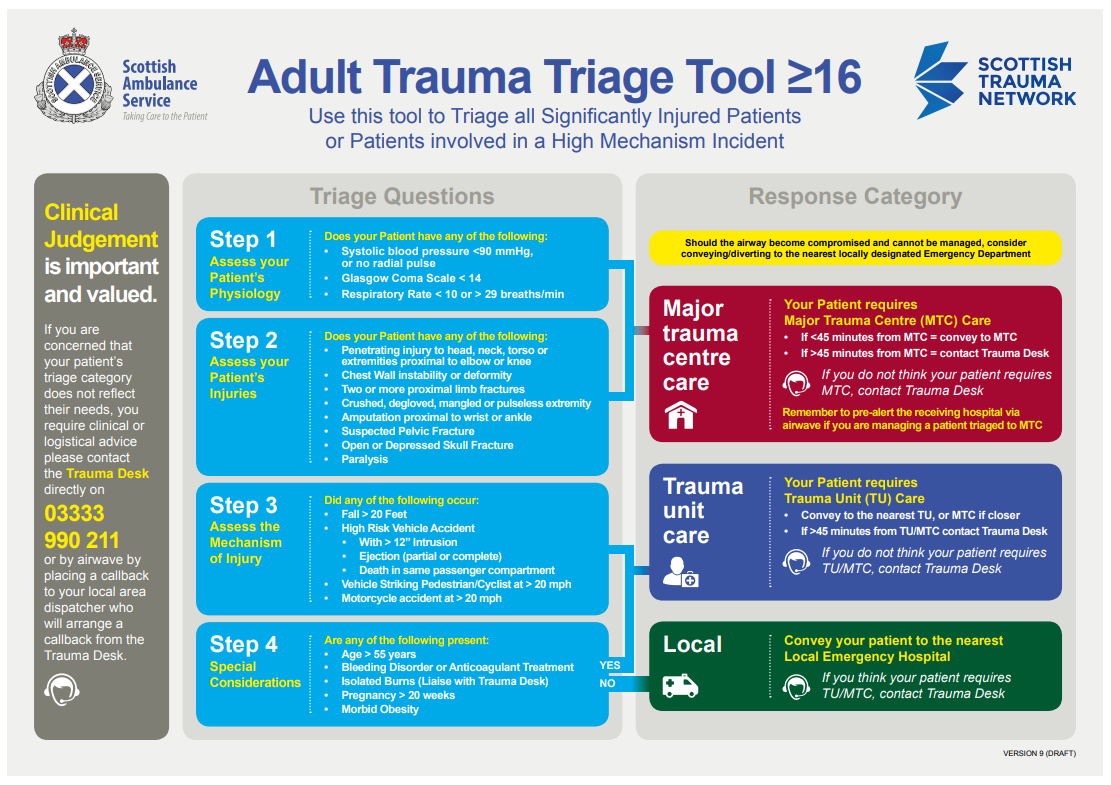
Scottish Ambulance Service Trauma Triage Tool
Further analysis by Metcalfe et al. (2014) in the West Midlands reported a 200% increase in patient volume at MTCs after network establishment, with no increase in mortality and an increase in the proportion of patients achieving a ‘good recovery’. While resource demands increased significantly - critical care days rose by 237% - the system coped well, with improved standardisation and reduced variation between hospitals.
McCullough et al. (2014) emphasised that the triage and transfer decisions (e.g., bypass to MTCs) are critical. Pre-hospital triage tools help ensure that patients with major trauma reach definitive care without unnecessary delays. However, over-triage (sending non-severely injured patients to MTCs) and under-triage (missing severely injured patients) remain tensions in the system.
McQueen et al. (2014) explored the operational impact of these networks on helicopter emergency medical services (HEMS), finding better tasking, reduced cancellation rates, and more scene interventions following network implementation.
The system has also adapted to the rural paradox - that is, trauma often occurs in rural settings where distances are greater and specialist care is harder to access. This has led to flexible models, including secondary transfer protocols and bespoke trauma desk coordination for retrievals from rural sites.
Sources
Lockey, D. J. (2018). Improved trauma outcomes after the introduction of a trauma system in England. EClinicalMedicine, 2, 3–4. https://doi.org/10.1016/j.eclinm.2018.08.002
McCullough, A. L., Haycock, J. C., Forward, D. P., & Moran, C. G. (2014). II. Major trauma networks in England. British Journal of Anaesthesia, 113(2), 202–206. https://doi.org/10.1093/bja/aeu204
McQueen, C., Crombie, N., Perkins, G. D., & Wheaton, S. (2014). Impact of introducing a major trauma network on a regional helicopter emergency medicine service in the UK. Emergency Medicine Journal, 31(10), 844–850. https://doi.org/10.1136/emermed-2013-202756
Metcalfe, D., Bouamra, O., Parsons, N. R., Aletrari, M. O., Lecky, F. E., & Costa, M. L. (2014). Effect of regional trauma centralization on volume, injury severity and outcomes of injured patients admitted to trauma centres. British Journal of Surgery, 101(8), 959–964. https://doi.org/10.1002/bjs.9498
Miller, S. (2010). How trauma networks can improve patient care. Emergency Nurse, 18(6), 14–18. https://doi.org/10.7748/en2010.10.18.6.14.c8027
With thanks to IMPACT - The Centre for Post-Collision Research, Innovation and Translation for their contribution to this content.