Implications for Delivery
Assisted and automated driving is a complex topic but there are key elements road safety practitioners should consider:
Understand Limitations of Automation
Automated systems are not infallible and still rely on human oversight at certain levels (particularly SAE L2–L3). Misuse or overreliance can lead to serious safety risks.
Communicate System Capabilities Clearly
Drivers and fleet operators must understand the differences between assisted and automated systems, especially regarding responsibility and liability.
Promote Driver Training and Awareness
Where assisted systems are deployed, professionals should support education and training on their safe use, including the risk of driver disengagement during supervision.
Support Safe Trials and Procurement Decisions
When planning trials or purchasing vehicles, professionals should ensure system limitations are accounted for, and that safeguards are in place, particularly to reduce driver distraction.
Apply Safe System Thinking
Consider automation as one element in a broader system. Vehicle design, user behaviour, infrastructure, and regulation must all be aligned to tolerate inevitable human error.
Monitor Emerging Evidence
Safety data from automation trials is promising but limited. Professionals should treat it cautiously and continue evaluating new research as evidence matures.
Consider Near-Term Gains over Full Automation
Low-speed, controlled environments (e.g. depots, warehouses) may offer immediate safety and efficiency benefits. These settings may also enable cost-effective development of advanced ADAS features.
Anticipate Wider Impacts
Automation may affect not only safety but also traffic flow, job roles, equity, and emissions. A holistic assessment is necessary when planning deployment.
Recognise the Public's Role
Public confidence is fragile. High-profile incidents can derail progress, so transparency, ethical standards, and robust testing are critical to building trust.
Background
Assisted and automated driving systems are complex, both technically and conceptually. Their development is often justified by crash data showing that human error contributes to a large proportion of collisions - frequently quoted at 90–95%. These errors range from distraction and speeding to impairment due to alcohol or drugs. The argument follows that machines, which don’t get distracted or drive under the influence, could perform better.
However, this traditional view is increasingly being challenged. It often assumes a legal perspective, where the driver is solely responsible for controlling the vehicle. If a crash occurs, it's deemed the driver's fault - even if the vehicle's design or handling played a role. Safe System thinking shifts this perspective. It accepts that humans will make mistakes and promotes designing vehicles and road systems that are more forgiving and protective when those mistakes happen.
It’s also important to remember that human drivers are, statistically, very safe. In 2023, there was one casualty every 2.5 million vehicle miles and one fatality every 200 million miles. If we benchmark automation against a consistently careful and competent human driver, the bar becomes even higher. Achieving or surpassing that level of performance with automation is a significant technical challenge - and not yet guaranteed to improve safety.
Tesla was the first to introduce a wide-ranging assisted driving system around 2015, which sparked a wave of ambitious claims about driverless cars. Yet a decade later, while assisted systems are widely available, true automation remains limited.
To better understand these developments, it's useful to clarify the terms “assisted” and “automated” driving. While not universally embraced, the SAE J3016 standard and its “levels of automation” provide a useful framework for distinguishing between the two.
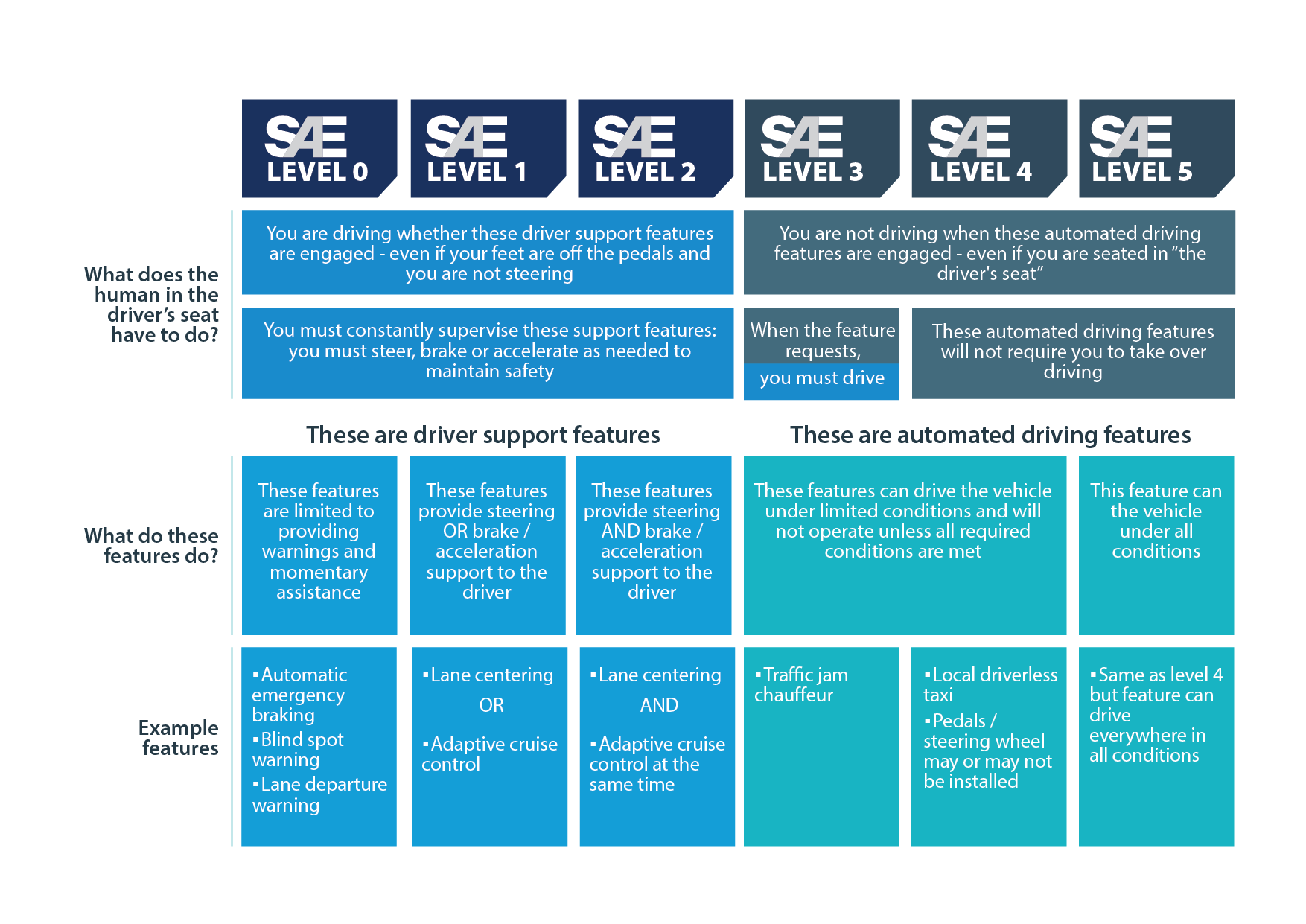
SAE levels of automation
Driver support systems
Level 0 is what has been referred to as Advanced Driver Assist Systems. The key element here is that the automated intervention is only momentary. The vehicle takes action for a short moment to help keep the driver safe or to avoid a collision; it does not take over driving for a sustained period. SAE level 1 and level 2 are clearly assisted driving and they do automate part of the driving task for a prolonged period. The critical part here is that the driver remains responsible for monitoring the driving environment and the assisted driving system status to ensure that they can intervene at any moment, if it is required to keep the driving safe.
Automated driving features
SAE level 4 and 5 are clearly automated driving. It is sufficiently safe that the driver can switch off from driving completely and, in fact, there may not even be manual driving controls in the vehicle. The difference between level 4 and level 5 is that level 4 can do this only under certain conditions, or for certain mapped roads (in what is known as the operational design domain). Level 5 can do this under all conditions for all roads. It is questionable as to whether a true level 5 will ever become reality.
The challenge between levels 2 and 3
The controversy arises with SAE levels 2 and 3. In theory, humans are imperfect drivers, and an SAE level 2 ‘driver’ is also imperfect but in different ways. Thus, the strengths of the SAE level 2 system (e.g. constant vigilance, never drunk or distracted) can compensate for the weakness of the human driver in those areas. The strengths of the human driver (perception and judgement, even in difficult or unusual situations) can compensate for the weaknesses of the L2 system in those areas. In theory, the sum of the two should provide a better safety outcome than either of the two do individually. However, in practice, another human weakness is that we are typically not very good at supervision tasks where we don’t do very much ourselves. It is boring; it can make us sleepy; and where the machine seems to be doing quite well, we might decide to do other things that are more interesting, like texting or watching films. This can mean that when the moment comes and a dangerous traffic situation arises that the L2 system cannot handle, the supervisory human driver can also fail to show up and do their job. The open question is what the net result of the theory and the practice is: will it be better than human driving or worse?
The change to L3 is principally one that indicates the manufacturer has the confidence to declare that during normal driving, the system is sufficiently competent not to need supervision. The driver no longer needs to supervise the system but must remain engaged with the vehicle because in a level 3 system, it still relies on the human driver to act as a ‘fall back’ in case the system itself recognises that it is no longer capable of sustaining the automated driving. In this scenario, the driver must be ready to take back control from the vehicle, within a time period of a few seconds.
Handing back control
A range of human factors studies have suggested that it can take substantially more time for the driver to properly and competently retake control than the systems can typically provide for that purpose. However, manufacturers in this area also cite their own studies showing that when the driver is engaged in the infotainment system, where the message to retake control is issued, the driver can achieve competent control in only a few seconds, within the time the vehicle can offer.
Regulation and liability
In most jurisdictions, (and in theory, in the UK), a level 3 system would be considered automated and not assisted and so the manufacturer would have to accept liability for collisions caused by a failure in the self-driving technology. Level 3 systems intended for motorway driving have been Regulated by the UNECE as ‘Automated Lane Keeping Systems (ALKS)’. Most manufacturers have not been confident enough to move to L3, and have produced a range of systems with ever more functionality but still requiring supervision, such that they are assistance systems still. These have been called things like L2+ and L2++. In 2024, they were formally regulated by the UNECE as ‘Driver Control Assistance Systems’ (DCAS) and are based on the principle that drivers must still retain responsibility for safe operation but can take their hands off the steering wheel. The systems must include features to monitor and engage the driver. L2 systems that require hands on the wheel are regulated under more general UN Regulations on steering systems. There are strong concerns about how well normal consumers will be able to understand the differences between these systems and what it means for their responsibility and liability for any collisions.
Mercedes was the first company to market with an L3 system in their passenger cars, but they only make it available in some countries, not including the UK.
Euro NCAP has implemented safety ratings for assisted driving in passenger cars. The tests include situations where early systems were found to struggle:, for example, in an S-bend or with vehicles suddenly cutting into the lane etc. However, a very key aspect of the assessment is how well the system works with the driver and ensures that the driver remains engaged in the driving task.
UK application
L4 automation in the UK has been limited to trials, pilots, and demonstrations, though in at least one project, there has been commercial fare paying passengers. In general, automation has two enemies: Speed and complexity. Motorways are our least complex roads and so are one environment where advances are made, but they are fast. Urban roads are low speed, but are complex. At least initially, L4 automated vehicles are likely to be expensive, which can undermine the business case of low volume passenger services (e.g. pods and shuttles). However, for trucks and buses, depots and warehouses are often seen as early use cases. They are low speed environments and can be relatively controlled to minimise complexity, and by reducing the time drivers spend moving vehicles around for loading, unloading, fuelling/charging and washing, they can still provide a business case to justify the cost.
What the Research Shows
A huge body of human factors literature demonstrates the problems that can occur with humans supervising automation. There are now many examples of documented abuses of the systems and serious and fatal collisions where systems have been active and both system and driver have failed to detect, and to respond to, the hazard correctly.
However, in terms of quantifying net differences in safety in terms of collision statistics, it remains early days. Tesla began releasing safety data in relation to its L2 assisted driving system, which it branded as ‘autopilot’ and found that with autopilot active, a collision was experienced once every 7 million miles, compared with once every 1.5 million miles for its own vehicles when not using autopilot (and around once every 0.75 million miles for America as a whole). However, this information was subject to considerable and justified criticism for not comparing ‘apples with apples’. For example, autopilot is mostly used on major highways, which are much safer than other roads generally. Tesla vehicles were both new and expensive which means they tended to be bought by older more experienced drivers. Meanwhile, the comparative figures for the whole of the USA included the crash rates of all vehicle types including motorcycles, HGVs and buses.
Waymo has also started releasing data to assess the safety of its robotaxi services. However, it has attempted to counter some of the biases for which the Tesla data was criticised. For example, it has limited the analyses to comparisons with human driven crashes in the areas and on the types of road that their robotaxi service operates on. This process will not be perfect and potential for bias remains, but it is a positive step in the right direction. The results suggests that the automated vehicles have considerably reduced crash rates, by as much as 80% to 90% in some crash types, which highlights the potential. However, it is important to note that at the time of writing, the analysis was based on 71 million miles of driving by their robotaxi service. In human driving in the UK, the expected injury crash numbers based on average rates (all vehicles on all roads) would be only 30 and a fatality wouldn’t be expected until nearly three times that much mileage was accumulated. So, this remains a small sample and still represents the early stages of emerging evidence.
Despite the attempts to reassure the public that the safety statistics back the argument for automation, public perception of the safety of driverless vehicles is volatile and important. There have now been at least two cases where a driverless operation has completely shut down following a fatal collision and the public reaction and criticism of the failings that led to it.
What is Next?
The delivery of safe assisted and automated driving remains a very challenging area and actors in the delivery of this need to challenge all assumptions and ensure all aspects are considered holistically, not just in terms of safety but in terms of the economy, jobs, and the effect on traffic, social inclusion, and emissions.
For trials, clear guidelines are now available from Government and there are a number of insurers with experience that can be consulted.
When considering whether to buy vehicles with assisted driving functions (as opposed to momentary safety interventions, like AEB), then fleets may wish to consider the likelihood of their drivers being tempted to undertake secondary tasks while driving and the balance of risks if the systems are seen to be enabling them. Training in the limitations of the systems may be beneficial.
It is generally acknowledged that widespread automated driving is still some years away. However, there may be routes to better exploiting the technology. For example, the sensor sets used for automated driving are generally much more sophisticated and expensive than those used for things like AEB, where cost is an issue because although fleets and drivers may see the safety benefit, it is very rare they see that benefit and it is something they hope and expect never to need. If a business case for automation can be made for something like automated depot driving in an ‘easy’ low speed-controlled environment, it won’t yet be sophisticated enough to drive the vehicle on the road. However, it will have more sophisticated sensors and more computing power than normal ADAS. At this point, there may be opportunities to develop new and improved SAE L0 ADAS functions that can have a much more immediate effect on safety than full automation. Looking out for these shorter-term opportunities may not only be positive for safety now, but may also be positive for the economic models of those who have invested in automated driving but find its at-scale commercial implementation delayed.
Sources
European New Car Assessment Programme (Euro NCAP). (n.d.). Assisted driving gradings explained. https://www.euroncap.com/en/car-safety/the-ratings-explained/assisted-driving-gradings-explained/
Institute for Transport Studies, University of Leeds. (n.d.). Human factors and safety [Web page]. https://environment.leeds.ac.uk/transport-human-factors-safety
Tesla, Inc. (n.d.). Vehicle Safety Report. https://www.tesla.com/VehicleSafetyReport
With thanks to Apollo Vehicle Safety for their contribution to this content.