Implications for Delivery
Barriers are core Safe System treatments. They reduce crash severity and significantly cut Fatal and Serious Injuries (FSI), especially on high-speed, high-volume roads.
Barrier choice matters –
Flexible: best energy absorption, lower cost, but higher deflection and post-crash costs.
Semi-rigid: balance of cost, strength, and deflection.
Rigid: lowest deflection and maintenance, suited for protecting critical assets/heavy vehicle routes, but highest installation cost and less forgiving to road users.
Trade-offs to consider – barriers can themselves create hazards. Practitioners should only design/specify systems if qualified, ensuring compliance with EN 1317 standards, understanding limits of crash testing, and considering the risks to motorcyclists.
Context-specific decision-making – rigid barriers may be preferable where traffic disruption costs are high, assets are critical, or heavy vehicle volumes are significant.
Integration with network risk assessments – barrier installations should align with Safe System “End State” objectives and prioritised using tools like the Road Restraint Risk Assessment Process (RRRAP).
Background
In the Safe System, one of the key principles is that everyone makes mistakes, and that people do not deserve to be harmed from those mistakes. Road safety barriers are an important part of creating a safe road system by reducing the severity of crashes when vehicles leave the road.
Road safety barriers are usually applied to high-speed routes (above 50 mph) or where there is a significant risk to an errant vehicle, e.g. at an overbridge. This information is therefore most relevant to motorways, trunk, and non-trunk roads with permanent speed limits of 50 mph or more and two-way traffic flows of 5,000 annual average daily traffic (AADT) or more.
We have categorised road safety barriers into three location types:
Three-Barrier – These barriers are installed as a three (one on either side and one between opposing carriageways) to prevent errant vehicles from veering off the road, shield against roadside hazards, and reduce the risk of head-on collisions. This type is found on higher AADT route, such as the “M” roads in Scotland.
Median Barriers – these barriers are installed to protect errant vehicles from head-on crashes. They also have complementary benefits of reducing overall run-off road crashes.
Roadside Barriers at High-Risk Sites – these roadside barriers are targeted at high-risk sites, such as the outside of curves.
Road safety barriers are considered Primary Safe System Treatments. Primary Safe System treatments are those which align with the safe system approach to fundamentally impact the risk of death or serious.
Permanent Barrier types are generally split into the following categories:
Flexible – wires capture vehicles and deflect (absorbing the greatest amount of energy). Motorcyclists have raised concerns with the use of flexible barriers, but research has shown that they are no greater risk than semi-rigid barriers.
Semi Rigid – containing two post varieties: strong post or weak post. Strong posts rotate, providing structural strength to the rail. Weak posts bend at ground level, with the ribbon tension of the rail providing strength.
Rigid – usually concrete barriers. The energy is “absorbed” by the transfer of horizontal kinetic energy to gravitational potential energy through deflecting vehicles up. That is, the rigid system does not deflect itself.
There are also temporary barriers, which are used during time-limited hazards, e.g. road works, to minimise the risk to road users. Their secondary benefit is protecting road workers.
What the Research Shows
Road safety barriers provide a significant improvement when protecting hazards. They also demonstrate a safety improvement on clear zones.
Three barriers achieve an approximately 75% reduction in Fatal and Serious Injuries (FSI), generally on higher AADT routes. Associated issues include higher construction costs due to required widening, roundabouts/turnaround facilities and passing lanes.
Median barriers achieve an approximately 65% FSI reduction and are generally for mid to high AADT routes.
Roadside barrier at high-risk sites achieve an approximately 30% FSI reduction when installed on 250 m per km.
Key considerations
While roadside barriers generally represent an overall risk reduction, they are themselves a hazard. It is important that those designing and approving barriers are qualified and understand the purpose for the barrier.
The barrier system should be approved by EN 1317 Road Restraint Systems. A pre-requisite of this approval is the approved crash testing. Crash testing does not always reflect real-life conditions, so caution is required when interpreting the results strictly.
The following table summarises factors which may impact the selection of barrier system.
Safety to Road Users | Deflection | Install Cost | Suitability for Heavy Vehicles | Post-Crash Cost | Maintenance Cost | |
|---|---|---|---|---|---|---|
Flexible | Highest | Highest | Lowest | Lowest | Highest | Medium |
Semi-Rigid | Medium | Medium | Lowest | Lowest | Medium | Medium |
Rigid | Lowest | Lowest | Highest | Highest | Lowest | Lowest |
Rigid barriers, while not always the safest for road user, may be the most appropriate solution. Factors that may support the selection of a rigid barrier include:
economic cost of delaying traffic for repairs or maintenance is high,
there are critical assets to protect or non-moveable structures
there is a high risk if a vehicle penetrates the barrier
there is a high proportion of heavy vehicles
Treatment locations should be prioritised in association with network assessment. National Highways (formerly Highways England) provides a ‘Road Restraint Risk Assessment Process' (RRRAP) to help prioritise barrier locations, and should be considered alongside Safe System End State or Step Towards objectives.
The Role of Roadside Barriers in Motorcycle Related Crashes
Roadside barriers, while effective in protecting vehicle occupants from roadside hazards, can pose significant safety risks motorcyclists in the event of a crash, resulting in high injury severities.
Naturally, motorcyclists who enjoy limited protection, are far more likely to be fatally injured upon impact with a safety barrier compared with car occupants. A study of US crashes between 2000 and 2005 found that approximately one in eight motorcyclists impacting a safety barrier was fatally injured, compared with only one or two of every 1,000 car occupants.
Even though they reduce the risk of serious injury compared to hazards like trees and poles, safety barriers can still pose significant injury risks to motorcyclists. Impacts with safety barriers are a factor in between 8 and 16 percent of motorcycle fatalities internationally. In Sweden, the ratio of serious motorcycle crashes resulting a road death were higher than average.
The nature of injuries does depend on how the motorcyclist impacts the barrier. For example:
Upright Impacts: An impact in the upright position exposes the motorcyclist to sharp edges and protrusions connected to the upper areas of the safety barrier. However, studies suggest that injury severity and risk for medical impairment might be lower in crashes where motorcyclists collide with the barrier in an upright position compared to sliding into it.
Sliding Impacts: If a motorcyclist impacts the safety barrier after sliding along the ground, there is a significant chance of impact with the barrier posts which are rigid in nature, creating high force impacts on the motorcyclist's body. Post-centred impact with a standard W-Beam alone at 60 km/h (37mph) indicates that the force would most likely result in a fatality. Sliding crash configuration tests against steel guard rail and concrete barriers have been shown to produce lower impact forces, suggesting higher survival rates where these barriers are in use.
Improvements to Barriers
Motorcyclist Protection Systems (MPS) have been developed to reduce the injury risk from barrier impacts. The function of MPS is to protect sliding motorcyclists from impacting support posts, continuing underneath the existing barrier and into other hazards or to minimise re-entry into a live traffic lane. MPS are intended to absorb kinetic energy during an impact and reduce the opportunity for the rider to experience a sudden deceleration. There are different types of MPS on the market:
Continuous systems: These consist of an additional rail (sometimes called a rub rail) that fits between the barrier rail and the ground. They deflect and deform to absorb impact energy, while functioning as a continuous guide to redirect the motorcyclist along the barrier. Studies indicate that installation of continuous systems can potentially reduce fatal injuries to more minor injuries, and the likelihood of head injury is more than halved for either an upright or sliding impact.
Discontinuous systems: These consist of a protective 'cushion' that surrounds the individual posts supporting the barrier. The deceleration forces for a chest impact are almost halved when impacting a discontinuous system.
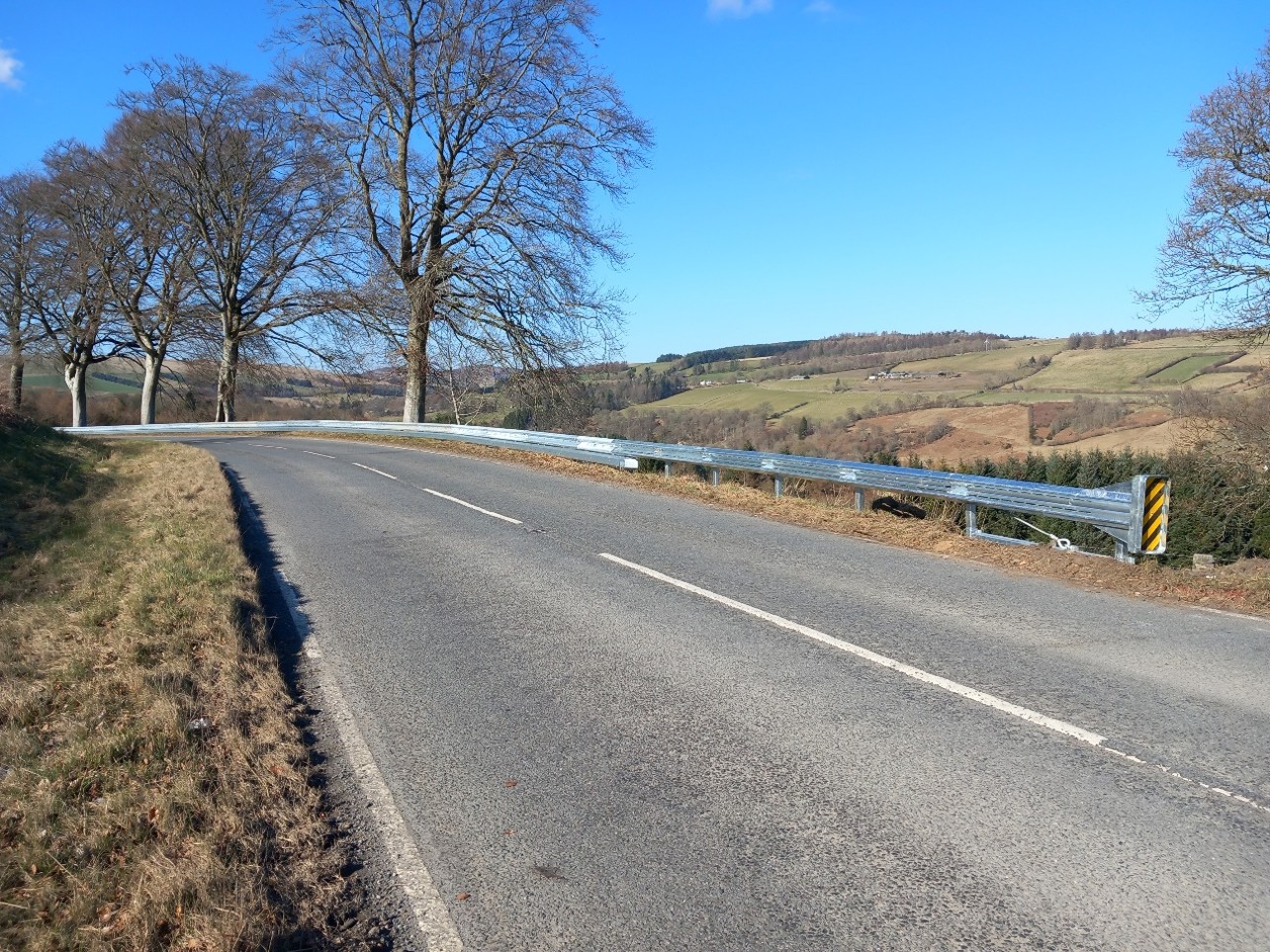
Flexbeam continuous barrier installation in Scotland
What About Wire-Rope Barriers?
While the Swedish motorcycle community has expressed concerns about wire rope barriers, studies suggest that they do not imply a higher injury risk for motorcyclists than other steel guardrail barriers. Furthermore, the installation of median wire rope barriers on 2+1 roads in Sweden resulted in a substantial reduction (65%-70%) in fatal and severe motorcycle crashes, compared to standard 13-meter-wide roads without a wire-rope median barrier.
Sources
Austroads. (2015). Improving the performance of Safe System infrastructure: Final report (AP-R498-15). Austroads. Retrieved from Austroads publication page
Austroads. (2018). Towards Safe System Infrastructure – A compendium of current knowledge (AP-R560-18). Austroads.
Austroads. (2024) Flexible median barriers (undivided rural highways). Road Safety Engineering Toolkit. Retrieved from Austroads Road Safety Engineering Toolkit
Baker J., Eveleigh M., Burrows A.; A Crash Testing Evaluation of Motorcyclist Protection Systems for use on Steel W-Beam Safety Barriers (2017), Journal of the Australasian College of Road Safety.
European Committee for Standardization. (2010). EN 1317: Road restraint systems – Performance classes, impact test acceptance criteria and test methods for safety barriers. Brussels: CEN.
Grzebieta R., Jama H., McIntosh A., Friswell R., Favand J., Attard M., Smith R.; Overview of Motorcycle Crash Fatalities Involving Road Safety Barriers (2009), Road Safety Research, Policing and Education Conference.
Highways England. (2011) The Road Restraint Risk Assessment Process (RRRAP). Retrieved from Guide to the RRRAP – GOV.UK
International Road Assessment Programme. (2022). Road Safety Toolkit. Retrieved from https://toolkit.irap.org/
Standards for Highways. (2021). CD 377: Requirements for road restraint systems (Revision 4). Design Manual for Roads and Bridges. Retrieved July 26, 2025, from https://www.standardsforhighways.co.uk/tses/attachments/1fe48581-82ba-4b6f-95a1-ee93309bd1b5?inline=true
Transport Scotland. (2021). TS Interim Amendment No. 38: Temporary Barrier Decision Tool (TBDT). Retrieved July 26, 2025, from https://www.transport.gov.scot/media/6099/ts_ia_38_-temporary_barrier_decision_tool.pdf
With thanks to Safe System Solutions for their contribution to this content.