Implications for Delivery
Road markings are supporting safety treatments – not transformative on their own, but cost-effective measures that contribute to reducing serious and fatal crashes. They are most effective when targeted to high-risk locations such as rural roads, curves, and undivided carriageways. The following are key treatments and their benefits:
Edgeline markings – Improve lane discipline and reduce run-off-road crashes. General crash reduction of ~5%, increasing to 10–30% on curves. High visibility materials (reflectorised, glass beads) enhance effectiveness, especially at night or in wet conditions.
Raised pavement markers (studs) – Enhance visibility in poor weather and provide tactile feedback. Contribute to a 6% crash reduction, with strong cost-benefit returns in low-visibility or lane departure risk areas.
Audio tactile markings (ATLMs) – Raised/ribbed “rumble” lines that alert drivers when drifting. Deliver significant crash reductions: 20–30% fewer run-off-road crashes, 20–55% fewer head-on crashes with centreline application. Deployment should balance safety gains with potential noise concerns. Emerging sinusoidal profiles may help reduce external noise while maintaining in-vehicle feedback.
Centreline markings – Essential for guiding drivers and reducing head-on risk.
Wide centreline treatments – Create 500–1500 mm separation between opposing traffic flows. International evidence suggests up to 35% fewer head-on crashes. These are worth considering for future Scottish pilot schemes.
Background
As part of Scotland’s commitment to Vision Zero and the Safe System approach, several road marking treatments offer cost-effective, high-impact contributions to reducing fatal and serious injuries. These measures are not transformative on their own, but they serve as valuable Supporting Safe System interventions, within the broader road safety strategy.
Edgeline markings support lane discipline and help prevent run-off-road incidents. These markings are commonly reflectorised with glass beads and made with high-specification materials to improve night-time and wet-weather visibility. Their presence is particularly beneficial on rural and undivided roads where edge definition is critical.
Raised pavement markers, or studs, provide an additional layer of delineation, enhancing visibility in adverse conditions and offering tactile and auditory feedback to drivers. Their use complements painted edgelines and contributes to safer lane keeping, especially on higher-speed roads.
Audio tactile markings, also known as raised profile, ribbed or rumble strip line markings, alert drivers through sensory feedback when vehicles stray from their lane, helping reduce errant driving. These markings are especially effective on edgelines. It is important to note that audio tactile centreline markings are currently not permitted under Chapter 5 of the Traffic Signs Manual, as adopted in Scotland.
Centreline markings remain essential for guiding motorists and reducing the likelihood of both head-on and run-off crashes. Treatments must conform to the Traffic Signs Regulations and General Directions (TSRGD) Chapter 5 specifications, including limitations on tactile features as mentioned above.
Wide centreline treatments, trialled internationally and supported as Safe System interventions, enhance safety by increasing lateral separation between opposing traffic flows, typically ranging from 500 to 1500 millimetres. While not currently defined within Chapter 5, their adoption in Scotland may warrant further investigation as a future safety innovation, subject to authorisation by Transport Scotland.
What the Research Shows
The installation of edgelines has been shown to improve road safety by approximately 5% across general applications. When targeted at high-risk locations such as curves, the crash reduction factor increases significantly, ranging from 10% to 30%.
Raised pavement markers contribute to a 6% reduction in crashes. While this figure may appear modest, the cost-benefit ratio exceeds 1, indicating that the safety benefits outweigh the implementation costs, particularly in areas with poor visibility or frequent lane departures.
Audio tactile markings, commonly referred to as raised profile, ribbed or rumble strip lines, have demonstrated substantial safety benefits. This treatment reduces run-off-road crashes by 20% to 30%. When applied to the centreline, they are associated with a 20% to 55% reduction in head-on collisions. These results suggest that ribbed centreline markings offer a strong cost-benefit case for deployment on rural networks and should be considered for wider implementation by Transport Scotland.
Wide centreline treatments are a relatively new intervention, and while research is still emerging, initial studies indicate a reduction in head-on crashes of approximately 35%, with reported ranges between 20% and 85%. These findings support further investigation and potential pilot schemes to assess their suitability for Scottish road conditions.
Key Considerations
The Traffic Signs Manual, Chapter 5 provides national guidance on the application and placement of edgelines and centrelines. International practices vary, but in many Commonwealth countries, edgelines are typically solid white. The standard width of edgelines ranges from 100 mm to 150 mm, with some jurisdictions trialling widths up to 200 mm in high-risk areas to enhance visibility and driver awareness.
Raised pavement markers have defined applications within Scotland. Chapter 5 of the manual outlines their appropriate use, including colour conventions such as red to indicate areas not to be crossed and white for centreline delineation.
Audio tactile pavement markings have demonstrated significant safety benefits. These are included in Chapter 5, which outlines their design and placement. However, care is required in their deployment due to public feedback regarding noise.
Although not currently in widespread use in Scotland, international practice shows benefits in alternative placement strategies of raised (ribbed) line marking to reduce driver exposure. In areas with sufficient shoulder width, some jurisdictions install raised markings on the outside of the edgeline. Others are trialling sinusoidal (wave-shaped) milled-in profiles, which reduce external noise while maintaining effective in-vehicle feedback.
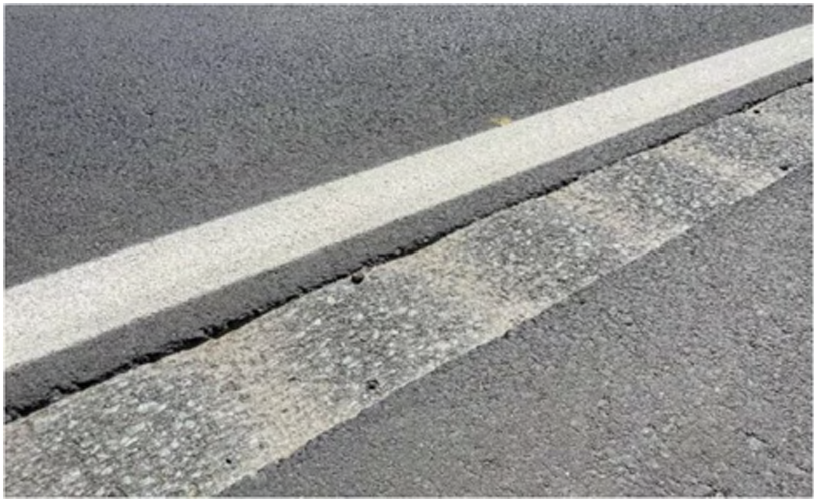
Sinusoidal ATLM treatment [Source: Le, J., Hsieh, O. & McIntyre, C., 2023]
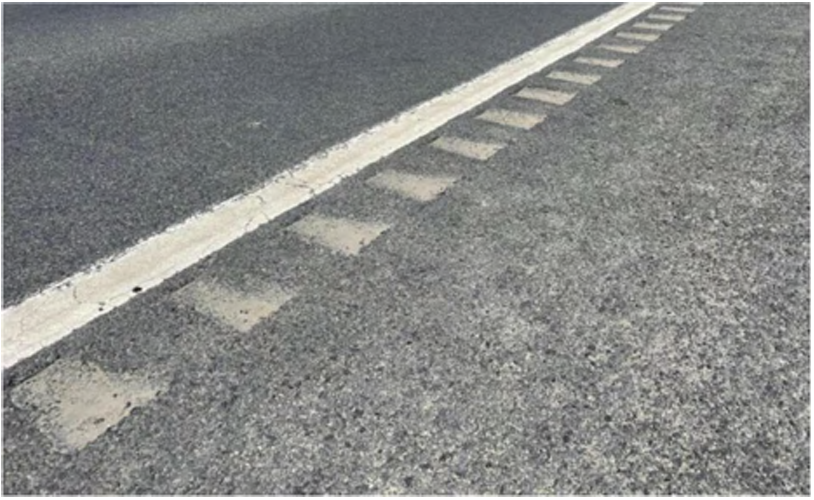
Traditional milled ATLM treatment [Source: Le, J., Hsieh, O. & McIntyre, C., 2023]
Wide centreline treatments, while not yet adopted in Scotland, are used internationally to improve separation between opposing traffic flows. These markings typically consist of a central separation ranging from 500 mm to 1500 mm, depending on road classification and safety objectives.
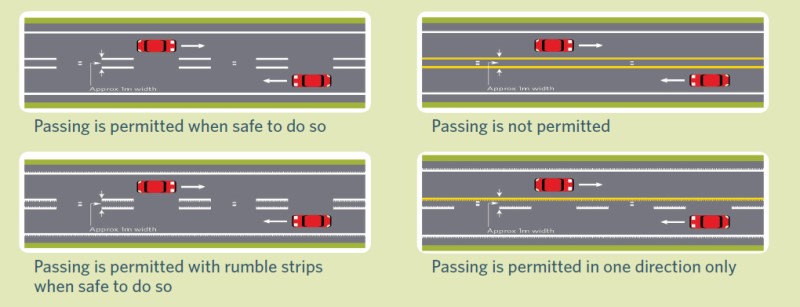
Wide Centreline treatment [Source: NZ Transport Agency Waka Kotahi, 2025]
Sources
Department for Transport. (2018). Traffic Signs Manual – Chapter 5: Road markings. Retrieved from Traffic Signs Manual – Chapter 5 – GOV.UK
Austroads. (2016). Guidance on median and centreline treatments to reduce head-on casualties (AP-R519-16). Austroads. Retrieved from Austroads publication page
Crash Modification Factors Clearinghouse. (2025). Crash Modification Factor for edgelines. U.S. Department of Transportation, Federal Highway Administration. Retrieved from https://cmfclearinghouse.fhwa.dot.gov/results.php
Elvik, R., & Vaa, T. (2004). The Handbook of Road Safety Measures. Amsterdam: Elsevier
Le, J., Hsieh, O., & McIntyre, C. (2023, September 19–21). Piloting sinusoidal audio tactile line marking (ATLM) in Australia. Paper presented at the 2023 Australasian Road Safety Conference, Cairns, Queensland, Australia. Transport for NSW. Retrieved August 29, 2025, from Conference Proceedings - ARSC 2025 Conference | Road Safety Excellence - Australasia
NZ Transport Agency Waka Kotahi. (2025) Wide centre-lines. Retrieved August 16, 2025, from https://nzta.govt.nz/roads-and-rail/traffic-control-devices-manual/part-5-traffic-control-devices-for-general-use-between-intersections/treatment-of-straights-general-delineation/treatments-in-the-centre-of-the-road/wide-centre-lines
With thanks to Safe System Solutions for their contribution to this content.