Implications for Delivery
Safe System practitioners should not only consider how they are delivering programmes across the network and with members of the public, it is also vital to ensure that efforts are also made to secure and retain support across the organisation. Considering how the organisation can become more effective in Safe System delivery may help to unlock additional resources and will serve to embed more effective behaviours in a variety of ways:
Identifying shared value – recognising that safety is dependent upon and delivers value for other organisational goals. This can help in building effective coalitions or engaging stakeholders as well as making a more effective case to decision-makers.
Vision & Values – leaders have a responsibility for safety, but helping them to see how the Safe System can be a way of achieving their ambitions, whilst improving the wellbeing of both the workforce and the wider community, can help to ensure that the vision and values of a Safe System become more integrated with other organisational goals.
Roles & Responsibilities – ensuring that we are delivering against our stated vision and values requires competent people with sufficient authority to act and a culture of accountability. Embedding these roles and responsibilities may take time and effort, but they will ultimately make a significant difference to organisational capacity and culture.
Policy & Practice – the best way to make sure that the right things are consistently done in the right way is to create effective corporate ‘habits’. This means creating the policies and practices that will ensure our ambitions are routinely delivered; over time this can have a powerfully transformative impact.
Background
The management of our road networks is not carried out in isolation. Responsibility typically sits within organisations that have a range of other responsibilities, such as Local Authorities who are tasked with overseeing education, social care and economic development. Even national transport agencies, like Transport Scotland, are balancing transportation needs across different modes. As organisations and their leaders juggle these diverse responsibilities, it means that we cannot take for granted that safety will always be prioritised over other goals. Proactively working within an organisation to ensure that safety receives an appropriate level of prioritisation can be just as important as delivering interventions out on the road network.
The Road Safety Framework to 2030 acknowledges that the Scottish Government and its partners face a wide range of priorities such as health, education, climate, inequalities and justice (see Figure 1 below), so efforts on road safety are framed as supportive actions for a wider range of policy priorities. In this section we will be exploring why and how we might choose to invest in influencing the culture of our organisations so that we can sustain continued focus and investment in the Safe System.
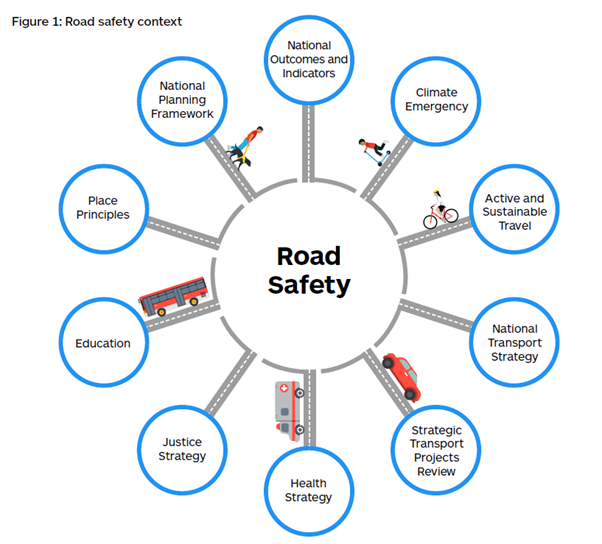
The Safe System recognises that our actions to enhance safety, come in a broader context where we need to integrate our efforts with other sectors and that systems-based approaches will help to deliver better outcomes in other areas as well. For example, reducing access to private motor vehicles on some roads will have effects on air quality, noise pollution and congestion, which in turn might influence healthier travel choices, increased outdoor play, improved social cohesion and longer dwell times at local shops that enhance the economy.
Understanding these relationships can help us to work within our respective organisations to raise the many benefits of safe mobility, influencing organisational culture and supporting continued investment.
What the Research Shows
Building organisational culture so that safety, and particularly the Safe System, remains the top priority can involve influencing a range of factors, many of which are addressed in Scotland’s Safe System Culture Playbook. Some of the most important factors that practitioners should be aware of how to influence:
Organisational motivation
We often hear statements like ‘safety is our number one priority’, but there is a disconnect between the ambition and the reality; the vision hasn’t been translated into the values. Safety can be both a goal and a value, something we aim for and also how we get things done. Working with leaders to ensure that the responsibility for keeping people safe and the benefits that arise from safety can help to shift the organisation’s motivation to prioritise safety.
A great example of this is the work of Paul O’Neill when he was boss of manufacturing giant Alcoa in the late 80’s. Refusing to sacrifice safety for profits or efficiency, he set out to make Alcoa the safest company in the world, aiming for zero injuries. The effect of this relentless focus changed culture, improved corporate communications, transformed stakeholder relationships and made the company 7x more profitable in just 12 years. We might not be looking for these sorts of financial goals, but they are the result of an organisation where staff feel well cared for and productivity increases as a result.
Organisational capacity
Embedding our vision and values for a Safe System, does require some capacity within the organisation getting the right people in the right places to sustain right sort of culture.
Some of the responsibility falls on leaders to promote the ambition for a Safe System, articulating a vision for a world where death and serious injury is not a consequence of mobility. Leaders are also critical for setting the strategy and agenda for change that will lead us towards this goal.
There are many other keys roles within organisations, particularly around ‘Champions’ who will encourage continued investment and foster innovation, ‘Connectors’ who work across the organisation and its stakeholder community to build consensus and powerful coalitions and what we refer to as ‘Scholars’ – those with deep technical expertise to ensure that our practice meets the highest standards.
Along with capacity goes the question of accountability. Organisations not only need resources that are capable of doing something, but there is also a need for key personnel to take responsibility and ensure that action happens.
Organisational activities
One of the most critical ways that our Safe System ambitions become effectively embedded in the culture, is by changing our policy and practice. If we have a policy of not approving road schemes that haven’t been through a Safe System assessment (a holistic review that tries to ensure that the scheme will minimise the opportunity for a serious crash) then all new developments and any remedial programmes should align with our Safe System ambition.
As well as changing our policy, we also need to embed these changes in practice through clear standards or guidelines and staff training. Standards can serve as a reference point to ensure that practices align with our organisational goals, while training will also help colleagues to recognise the importance of incorporating these standards into our practice as well as understanding how to do this effectively.
Sources
Burkus, D. (2020) ‘How Paul O’Neill Fought For Safety At Alcoa’, davidburkus.com. Available at: https://davidburkus.com/2020/04/how-paul-oneill-fought-for-safety-at-alcoa/
Campsall, D., Khatri, D., Fosdick, T., & Scott, S. (2024) The Safe System Cultural Maturity Playbook, Banbury: Agilysis Ltd. https://framework.roadsafety.scot/wp-content/uploads/2024/09/Culture-Playbook-v1.1-3.pdf