Implications for Delivery
Understand the basic principles of energy management and the importance of speed.
Use the research of Haddon and Reason as a way of exploring energy management strategies and understanding areas to target, within the system and across the phases of safety.
Background
Energy management is central to the Safe System. The system components need to work together to protect fragile humanity from harmful energy release during a collision.
Energy is strongly linked to speed. Kinetic energy is equal to
 Doubling vehicle speed increases kinetic energy by a factor of 4. Therefore, speed has a huge impact on the energy vehicles carry, and hence the risk to road users.
This section outlines the importance of energy management and some models for thinking about energy. Understanding these principles is an important start point for speed management and policy.
What the Research Shows
Injuries resulting from collisions are caused by the release of energy. Where the amount of energy released on or through a human being is large enough, injuries occur. Therefore, we need strategies for managing energy; fundamentally, this is what road safety interventions are trying to do.
In William Haddon’s 1970 paper “On the Escape of Tigers: An Ecologic Note”, he outlines several strategies for managing energy. Summarised, these involve:
Preventing the energy from building up in the first place
Preventing the energy from being released
Separating the release of the energy from humanity (for example by another material absorbing the energy)
Strengthening the human beings subjected to the energy release
Once the energy is being released, preventing its continuation
Energy build-up can be prevented by reducing the speed or mass of vehicles. Speed is the critical factor here, as kinetic energy is proportional to the square of the speed. This is why speed management is so important - small changes in speed can have a large impact on kinetic energy.
Once the energy is present, we must consider the release of that energy. It’s helpful to think about energy release within the phases of safety: primary safety, secondary safety and tertiary safety.
Primary safety features such as Autonomous Emergency Braking act to prevent a collision from occurring and hence prevent the release of energy in a dangerous way.
Once a crash has occurred, the release of energy needs to be safely managed and secondary safety features are a key part of this. Crumple zones and airbags extend the time over which the energy is released, reducing the peak force on vehicle occupants. Roadside crash barriers and other features should be designed to absorb as much energy as possible and redirect the release away from the vehicle occupant. Collapsing steering columns also crumple in a controlled manner on frontal impact, absorbing much of the energy.
Finally, once a crash has occurred and where the occupant is potentially in danger of further injury (for example through an explosion), quick connection to the emergency services is critical. Automatic door unlocking and other vehicle features can help occupants to remove themselves from other risks.
Human beings are inherently fragile, hence ‘strengthening’ them to cope with crash forces is not feasible. It is a core principle of the Safe System that humans cannot cope with forces above a certain magnitude and hence the system needs to account for that (see Speed and Human Tolerance to Injury in Safe System).
Another helpful way of thinking about energy release in a collision is by using Haddon’s Phase-Factor Matrix. This considers the key factors influencing risk across the elements of the road system:
The Host (Human)
The Agent (Vehicle)
Environment (Physical)
Environment (Social)
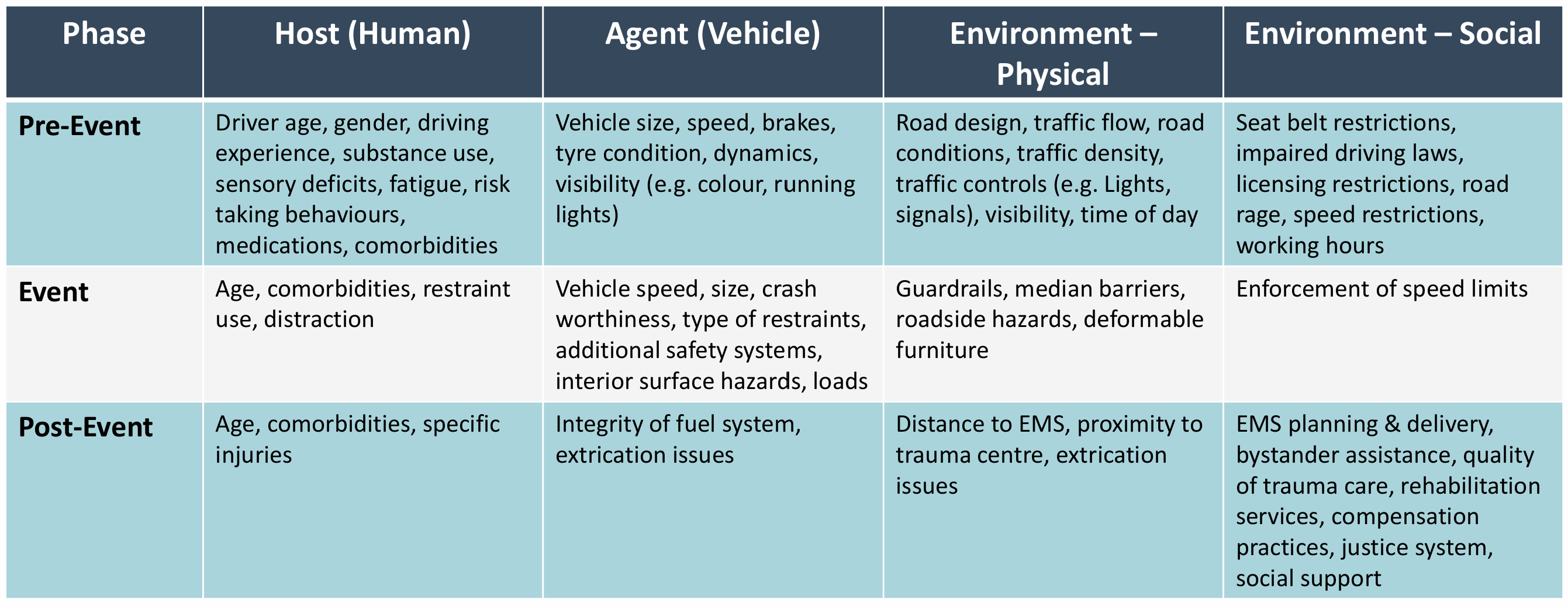
Haddon's Phase-Factor Matrix
There are factors which influence the ‘pre-event’, ‘event’, and ‘post-event’ phases of a collision. The outcome for the human is dependent on many things, including demographic factors such as age and gender. The vehicle and the physical and social environment need to work together to prevent harmful energy release, and crucially the amount of tolerable energy will not be the same for each person.
A related ’layers of protection’ idea was originally developed by Psychologist James Reason. The ‘Swiss Cheese’ model illustrates how the protective measures in the system need to work together to stop hazards entering the system from causing harm. For energy management, this means that the Safe System components need to combine to prevent the harmful release of energy that may result in death or serious injury.
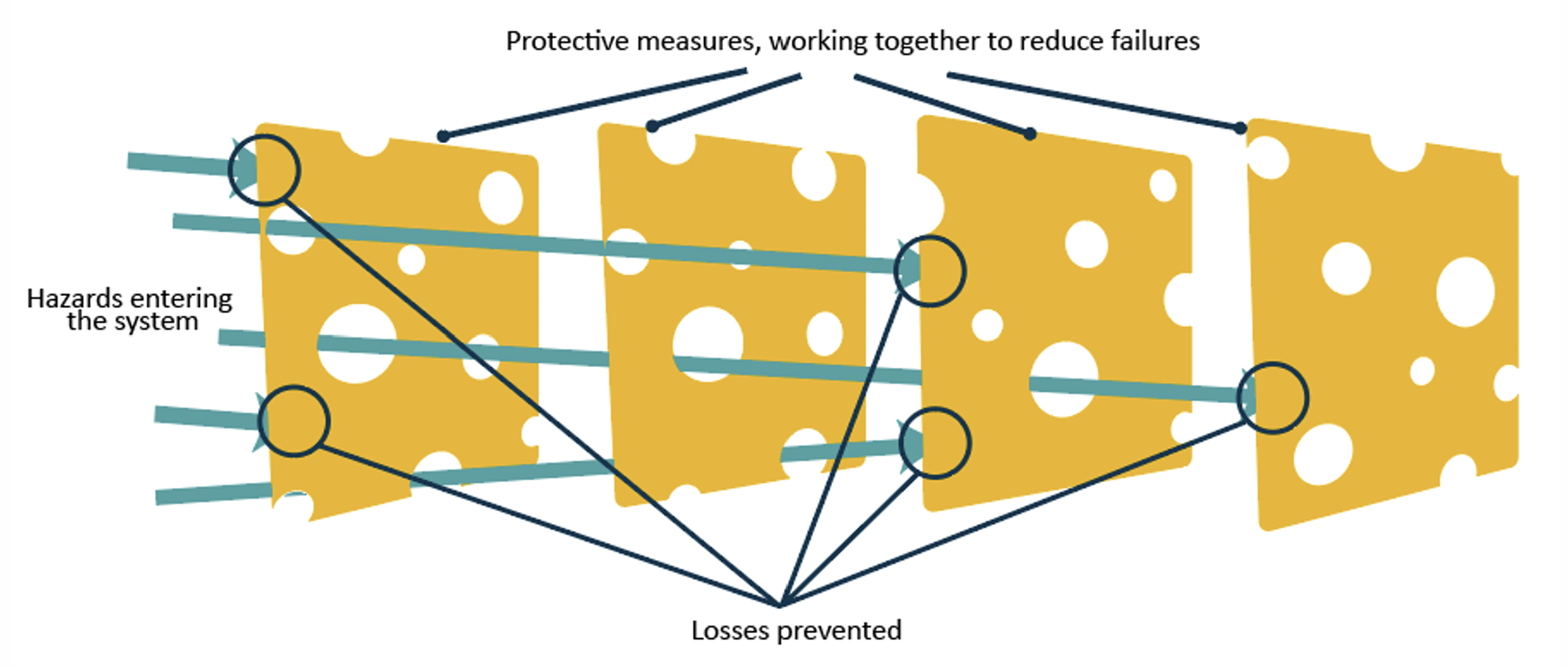
"The Contribution of Latent Human Failures to the Breakdown of Complex Systems” James Reason (1990)
Sources
Barnett, D. J., Balicer, R. D., Blodgett, D., Fews, A. L., Parker, C. L., & Links, J. M. (2005). The application of the Haddon matrix to public health readiness and response planning. Environmental Health Perspectives, 113(5), 561-566. https://doi.org/10.1289/ehp.7491
Haddon, W. Jr. (1970). On the escape of tigers: An ecologic note. American Journal of Public Health, 60(12), 2229-2234. https://doi.org/10.2105/AJPH.60.12.2229-b
Reason, J. (1990). The contribution of latent human failures to the breakdown of complex systems. Philosophical Transactions of the Royal Society B: Biological Sciences, 327(1241), 475-484. https://doi.org/10.1098/rstb.1990.0090