Implications for Delivery
Building a mature Safe System culture is more than an internal goal. It is key to support Scotland’s Road Safety Framework and realise our national aim of having the best safety performance in the world.
Cultural maturity models have long been used to evaluate the maturity of safety culture. Recently, Safe System Cultural Maturity (SSCM) models have emerged to help organisations understand how well the Safe System is embedded in their culture. For example, an organisation at the Advanced stage of SSCM will regularly assess whether initiatives or decisions align with the Safe System. They will also advocate for integrating the Safe System across all areas of work.
Organisations will be at different stages of cultural maturity, but here are a few steps to consider:
Evaluate current cultural maturity: Use a Safe System Cultural Maturity Model to evaluate where your organisation currently stands. Involve a range of stakeholders to get a full picture of how the Safe System is understood, discussed, and applied across the organisation.
Foster shared responsibility: Move away from a blame–focused approach and foster shared responsibility of the Safe System across all levels of the organisation.
Embed the Safe System in core values: Ensure that the Safe System is more than a procedural requirement, it should be reflected in your mission, vision, language and decision–making processes.
Adopt system–oriented language: The way we talk about the Safe System matters. Refer to ‘the Safe System’ rather than ‘the Safe System approach’ to reinforce its status as the norm, not an option. Encourage collective language that emphasises ‘we’ over ‘I’ to promote shared responsibility.
Progressing in cultural maturity is a long-term, organisation wide effort. While internal changes are key, valuable insights can come from external collaboration. Consider learning from peers, partners, and sector leading organisations who have embedded the Safe System successfully. A vital part of the Safe System is embracing that every organisation contributes to the system. Every step should reflect an understanding of how it fits the wider picture.
Background
Safety culture varies across organisations. Some demonstrate high levels of cultural maturity, while others are still understanding why safety should be prioritised. At its core, a safety culture is shaped by values, beliefs, attitudes, actions, and how easily people can act on them. These can be described as the “preconditions” for achieving a mature safety culture. They explain that values are often deeply rooted, while beliefs can change and be influenced over time.
A mature safety culture goes beyond improving health and safety outcomes. It helps organisations understand, communicate, and embrace the Safe System. This includes making safety a clear priority, avoiding a culture of blame, evaluating progress regularly, and supporting learning across all levels. Cultural maturity models are tools that help organisations check where they stand and how they can improve their safety culture.
When safety is a shared priority, it sets off a positive chain reaction. Senior leaders influence peer beliefs and actions which helps align workplace norms to a mature safety culture. An organisation that embeds the Safe System will also produce outcomes that reflect the Safe System. This can help Scotland to develop a mature culture, overtime building a national culture that supports rather than resists desired change.
Scotland’s Road Safety Framework highlights that adoption of the Safe System is required to achieve our vision of having the best safety performance in the world. This means recognising that internal organisational policies and cultural practices directly influence how road safety interventions are delivered. A mature culture and commitment to the Safe System go hand in hand and both are essential for fulfilling Scotland’s vision.
What the Research Shows
Cultural maturity models are widely used across a variety of sectors including mining, human resources, and transport to help organisations understand the maturity of their safety culture. One well known model is Hudson and Parker’s Safety Culture Ladder (Hudson, 2007) shown in Figure 1, below.
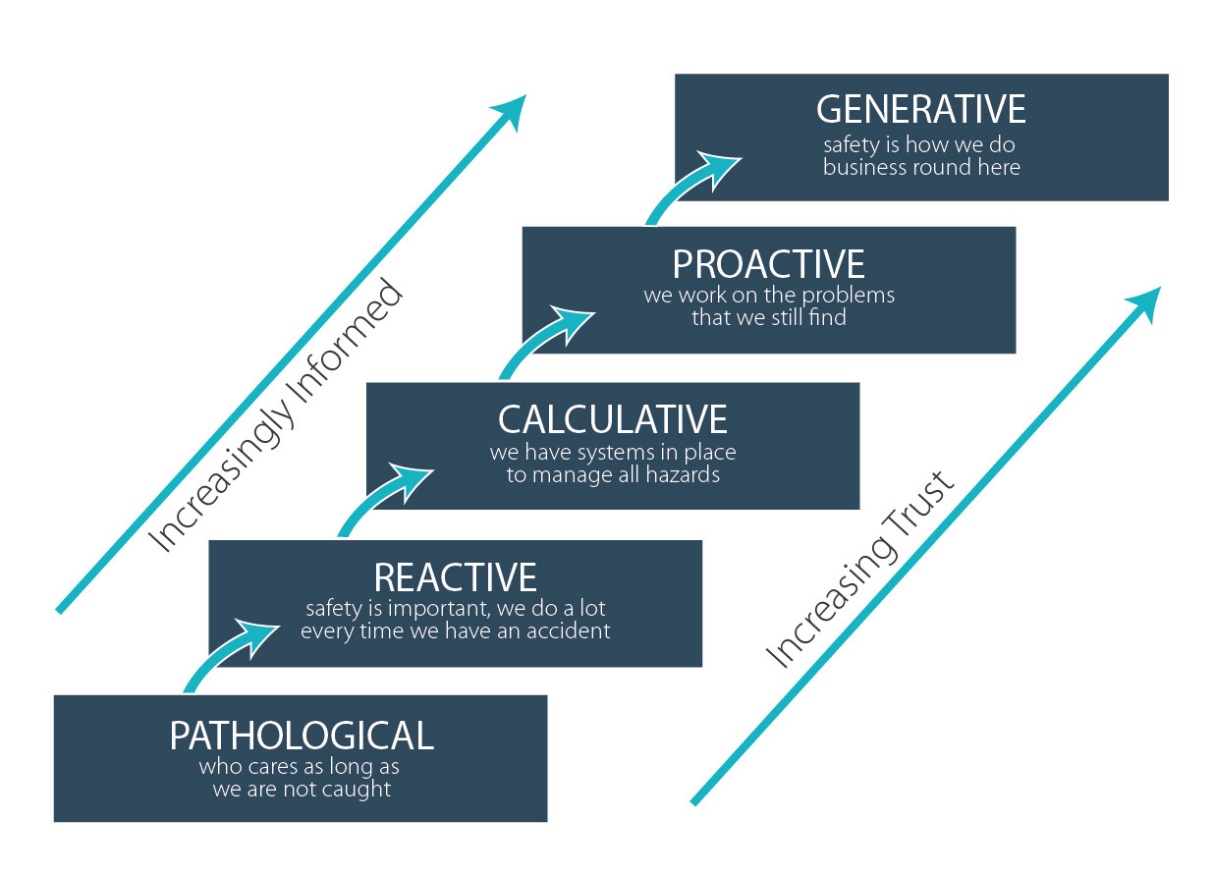
Figure 1. Hudson and Parker’s Safety Culture Ladder
The model highlights five stages of cultural maturity in an organisation:
Pathological stage: Safety is not seen as an important aspect. When things go wrong, stakeholders blame individuals rather than looking at the system.
Reactive stage: Measures are taken only in response to incidents.
Calculative stage: Safety becomes more organised, with systems and processes in place. However, initiatives are largely led by senior management.
Proactive stage: The organisation is proactive about safety with stakeholders across all levels participating in initiatives.
Generative stage: Safety is fully integrated into every aspect of the organisation. It is a shared responsibility embraced by everyone.
Safety culture, and by extension the Safe System mindset, begins to emerge only in the latter stages of the Safety Culture Ladder (Fosdick et al., 2024). Reaching the generative stage should be a shared goal for all Scottish organisations. Hudson and Parker’s model has been adapted by several organisations for developing new frameworks including the Asian Development Bank (Small et al., 2023), the International Transport Forum (ITF, 2022) and Agilysis (Fosdick et al., 2024).
All three organisations have adapted the stages of the Safety Culture Ladder to fit the wider Safe System context with redefining the stages as: Vulnerable, Emerging, Developing, Maturing, and Advanced. While the ITF framework offers a slightly different version, the core message remains the same. In the Vulnerable stage, safety is largely seen as the responsibility of road users, reflecting a blame culture. In contrast, the Advanced stage highlights that the Safe System is fully embedded in the organisation with shared responsibility and active involvement from all stakeholders.
To assess the Safe System Cultural Maturity (SSCM) of organisations Agilysis (Fosdick et al., 2024) created a SSCM model combining:
Hudson & Parker’s Safety Culture Ladder (See Figure.1 )
ISM model (See Figure 2)
Safe System model (See Figure 3)
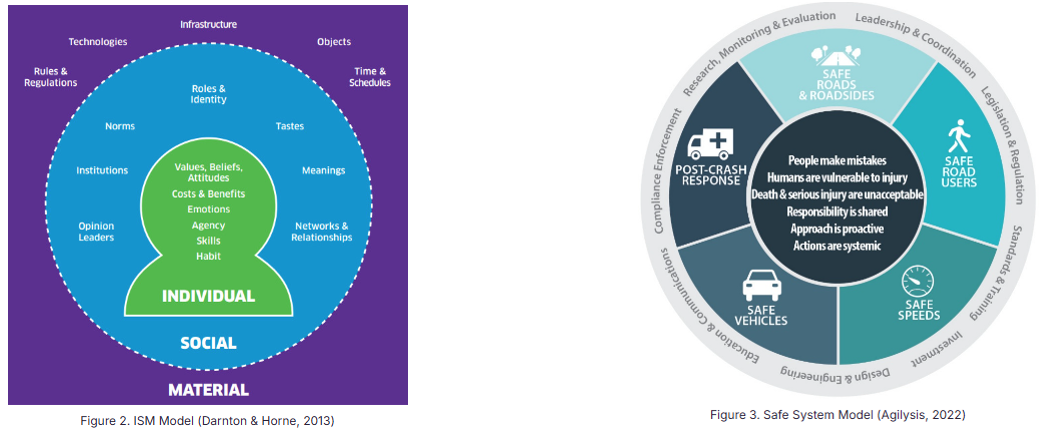
This forms the Safe System Cultural Maturity Model (SSCMM). SSCMM helps organisations evaluate how embedded the Safe System is in their culture by combining cultural maturity and behaviour change approaches (See Figure 4, below).
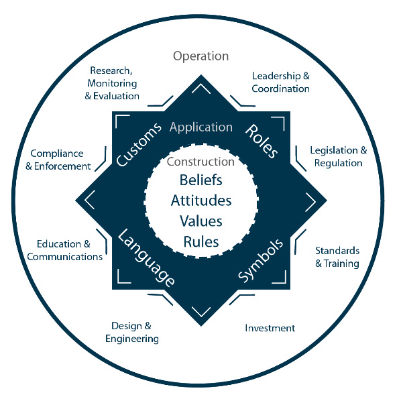
Figure 4. The Safe System Cultural Maturity Model
(Campsall et al., 2022)
The model is made up of three layers:
Construction stage (inner layer): Focuses on individual values, beliefs, attitudes and rules that shape how people think about the Safe System.
Application stage (middle layer): Highlights organisational norms, everyday routines, and language surrounding the Safe System.
Operation stage (outer layer): Covers the wider change mechanisms, such as research and evaluation.
For more details on SSCM stages, see Figure 5, below. Tools like SSCMM can help your organisation understand its current stage and identify clear steps to grow. To begin this journey, your organisation may want to reflect on the following questions:
How can we measure our organisation’s Safe System cultural maturity?
Have we adopted (or adapted) a cultural maturity model to guide our actions?
Do our internal policies, practices, and communications reflect the Safe System ethos?
Are we building a culture that supports the Advanced stage of SSCM? Can we remove any barriers for achieving this aim?
Are our goals and targets aligned with reaching the Advanced stage?
Have we identified which stakeholders can support this journey?
What do we say? | What do we do? | What do we think? | What do we need to do? | |
|---|---|---|---|---|
Vulnerable | “It’s not our responsibility – other organisations need to lead on this.” “We know what works.” “Safe System is expensive and unnecessary.” | Work in silos and only deliver what is necessary. No Safe System training. Poor communication with others. No data informing activities or monitoring of delivery. | “We don’t want to do anything that would make us culpable for mistakes.”
“Zero fatalities and serious injuries is an impossible target.” “Road user behaviour is poor. Enforcement is necessary but will never achieve full compliance.” | Need to start to take the Safe System seriously and develop an awareness that things can be done differently. |
Emerging | “We are starting to look at the Safe System, but we can’t influence all components.”
“We think we can carry on as usual in many ways” “Existing budgets are already stretched thin and accounting for new interventions is costly with few and far returns on investment.” | Use casualty data to direct enforcement and engineering.
Start to think about additional safety elements in engineering, enforcement, and education activities, when the data shows there is a need. Analyse casualties at sites we have enforced or engineered. | “We need to demonstrate that we have made a difference and the best way to do this is through casualty stats.” “We prioritise and adopt a ‘worst first’ approach.” “We have existing protocols and procedures in place, we don’t need more complicated novel systems that do not guarantee returns.” | Need to start to develop Safe System approaches, looking at structure, language, knowledge, attitudes. Need to identify where Safe System thinking is weakest and acknowledge we have a role to play. |
Developing | “Our leaders clearly state the Safe System is important to us.”
“We have had some Safe System training, where relevant.” “The Safe System can be an added burden.” | Managers set the agenda and direct our activities, but they don’t check up on implementation.
We work in partnership with a range of stakeholders. We have a road safety target. We monitor and evaluate activities beyond casualty data We have policies across Safe System components. | “The Safe System is something we are aware of, but it doesn’t really change the way I work.” “I think we act in a Safe System way (because leaders say we do) but I wouldn’t be able to explain it.” | Need to realise that the Safe System requires collaboration and proactivity.
Need to identify who else might need to be at the table. Need to embed Safe System thinking across the business. |
Maturing | “We’re actively trying to identify how we can work in a Safe System way.” “We’re identifying partners to collaborate with across all components.” | We bring together the components so that we star rate our roads and design to address speeds, road user behaviour and vehicle choices.
We deliver Safe System training across the organisation. We have adopted safety performance indicators. We believe there is a shared responsibility between us, our partners, external stakeholders and road users. | “We are working really hard on Safe System implementation, but we know we need to do more.” | Need to continue to bring everyone together, (internally and externally) to break down barriers to integrate the Safe System into the organisation. |
Advanced | “We don’t do anything without thinking how it first into the Safe System.” “We strive to eliminate road risk across the system.” “It’s what we do.” | Star rating, vehicle procurement choices, human-centred design, involving road users and stakeholders in design is all routine practice.
We actively promote and advocate for the Safe System with colleagues and partners. We are Safe System champions. We share best practice and help create guidance. We lead on research, evaluation and improving the Safe System evidence base. | “We can’t imagine thinking outside of a Safe System approach.” “Across my organisation and partners, we all share Safe System values and ambitions. We talk the same language and share the same attitudes.” | Need to keep working looking at everything through a Safe System lens and avoid backsliding. |
Figure 5. Safe System Cultural Maturity Stages (Fosdick et al., 2024)
Sources
Darnton, A., & Horne, J. (2013). Influencing behaviours - moving beyond the individual: ISM user guide. Scottish Government. https://www.gov.scot/publications/influencing-behaviours-moving-beyond-individual-user-guide-ism-tool/
Fosdick, T., Campsall, D., Kamran, M., & Scott, S. (2024). Creating a Cultural Maturity Model to Assess Safe System Readiness Within Road Safety Organisations. Journal of Road Safety, 35(1), 52–64. https://doi.org/10.33492/JRS-D-24-1-2125507
Hudson, P. (2007). Implementing a safety culture in a major multi-national. Safety Science, 45(6), 697–722. https://doi.org/10.1016/j.ssci.2007.04.005
Hudson, P. T. W., Parker, D., Lawton, R., & Verschuur, W. (2000). The Hearts and Minds Project: Creating Intrinsic Motivation for HSE. ResearchGate. https://doi.org/10.2118/61095-MS
ITF. (2022). The Safe System Approach in Action [ITF Research Reports]. OECD Publishing. https://www.oecd.org/en/publications/the-safe-system-approach-in-action_ad5d82f0-en.html
Scottish Government. (2021, February). Road Safety Framework to 2030 | Transport Scotland. www.Transport.Gov.Scot. https://www.transport.gov.scot/publication/road-safety-framework-annual-report/road-safety-framework-to-2030/
Small, M., Jordan, P., Anyala, M., Shelton, D., & Stapleton, R. (2023). Assessing the Maturity of National Road Safety Management Systems (No. 85). Asian Development Bank. https://doi.org/10.22617/WPS230159-2
Westrum, R. (1993). Cultures with Requisite Imagination. In J. A. Wise, V. D. Hopkin, & P. Stager (Eds.), Verification and Validation of Complex Systems: Human Factors Issues (pp. 401–416). Springer. https://doi.org/10.1007/978-3-662-02933-6_25/