Implications for Delivery
Rural roads account for a larger proportion of the road network and therefore installing route treatments can incur significant costs.
Not all high risk sites on rural roads are mapped and inventoried e.g trees >10cm diameter, presenting a challenge for those trying to install appropriate countermeasures.
Background
The definition of a rural road is very simple; any road that is outside a built-up area. In Scotland, the definition of built-up areas is based on Data Zones that are geographic areas of approximately equal population aggregated from Census Areas. Urban areas include small towns of 3,000 to 10,000 people. So, the term ‘rural road’ means any road that lies outside Data Zones with a town or city with a population of more than 3,000.
This means that the term “rural road” covers a broad range of road types from 3 lane motorways to narrow, single track, winding roads and almost everything in between. While the speed limit for multi-lane carriageways may vary between 50mph to 70mph, the speed limit that drivers are most likely to encounter on single carriageway rural roads is the national speed limit (60mph) with some lower speed limits on roads passing through smaller communities that do not meet the “built-up area” threshold.
As such road safety interventions that are designed to mitigate the impacts of higher speeds are those more frequently deployed across the rural roads network. For example, average speed camera enforcement, centreline road markings, bend warning signs, roadside vehicle restraint systems (VRS), and central medians.
Acknowledging that rural roads are often those with higher speed limits consideration should also be given to the distinct needs of specific road user groups, such as young drivers, motorcyclists.
What the Research Shows
Average speed camera (ASC) enforcement systems typically used over a longer stretch of road can be more effective in achieving compliance with the prevailing speed limit. Analysis of the impact of 25 ASC sites across Great Britain, found a 36.4% reduction in the mean rate of fatal and serious collisions in the post-installation period compared to before (Owen et al., 2016).
Analysis of the relationship between drivers’ perceptions of risk and the speeds they chose to drive found that the presence of double yellow and wide centreline markings were associated with lower speed choices and higher perceptions of risk. Similarly driving on narrower roads was associated with significantly lower speeds and increased risk ratings (Charlton & Starkey, 2016).
The use of innovative road markings for motorcyclists – Perceptual Rider Information for Maximising Expertise and Enjoyment (PRIMEs) on routes across Scotland led to statistically significant reductions in speed and statistically significant reductions in braking across multiple trial sites (Stedmon et al., 2023).
Run-off road crashes are common, especially on high speed areas. Research shows that the survival rate of a vehicle hitting an object head-on reduces dramatically above 70km/h while a vehicle side-impact into a pole or tree is greatly reduced at speeds above 30km/h. A number of engineering treatments can help to assist drivers in staying on the road (iRAP, n.d.).
Example: Scottish Borders Council 50mph Trial
Scottish Borders Council have installed 50mph speed limits on rural A- and B-class roads (A6088, A708, A7 and B6357) following recent motorcyclist fatalities on the routes. These limits have been accompanied by increased enforcement by Police Scotland. In 2025/26 motorcycle-friendly barriers and PRIME markings are being added to the routes. The trial is being evaluated at present, which is expected to complete in Summer 2026.
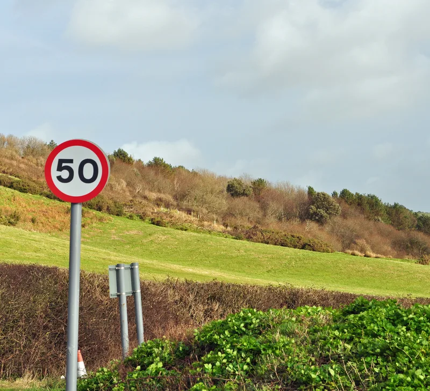
50mph speed limit in Scottish Borders
Sources
Charlton, S. G., & Starkey, N. J. (2016). Risk in our midst: Centrelines, perceived risk, and speed choice. Accident; Analysis and Prevention, 95(Pt A), 192–201. https://doi.org/10.1016/j.aap.2016.07.019
iRAP. (n.d.). Run Off Road – Road Safety Toolkit. Retrieved 25 July 2025, from https://toolkit.irap.org/crash-type/run-off-road/
Owen, R., Ursachi, G., & Allsop, R. (2016). The Effectiveness of Average Speed Cameras in Great Britain. RAC Foundation. https://www.racfoundation.org/wp-content/uploads/2017/11/Average_speed_camera_effectiveness_Owen_Ursachi_Allsop_September_2016.pdf
Stedmon, A., McKenzie, D., Langham, M., McKechnie, K., Perry, R., Wilson, S., Mackay, M., & Geddes, S. (2023). PRIME Road Markings for Motorcycle Casualty Reduction in Scotland. Human Factors. https://publications.ergonomics.org.uk/uploads/PRIME-Road-Markings-for-Motorcycle-Casualty-Reduction-in-Scotland.pdf