Implications for Delivery
There is a rigorous process in place for selecting sites for automated enforcement. Police Scotland undertook a review of the national guidance in place since 2007 to select cameras and subsequently updated its criteria to place a greater emphasis on more severe collisions and collisions involving vulnerable road users.
Other steps in selecting camera sites includes stakeholder reviews to decide the appropriateness of the site (and other engineering or education alternatives), speed surveys, and deciding which type of enforcement technology should be used.
Background
Safety cameras are placed at sites where enforcing the speed limit is likely to improve road safety. Safety camera programmes set out the rules related to where and how speed cameras can be installed. Under the National Speed Camera Programme, the Department for Transport set out criteria that needed to be met for speed camera sites to be installed. These criteria related to the collision history and speed profile at the site and were designed to ensure that enforcement was targeted at places with the greatest need. It also helped to explain to the public why enforcement was taking place.
Police Scotland Safety Cameras uses criteria established in 2022 to select sites. This builds on the previous criteria and sets out the site length, collision history, vehicle speeds, and the suitability of the site required for a location to be chosen. There is also a process in place for flexible deployments: enforcing in other areas to improve driver behaviour and speed limit compliance (Scottish Safety Camera Programme, 2022).
Site Selection Guidance
The National Safety Camera Programme ended in 2007, when there were changes in funding arrangements for safety cameras. At this time, the Department for Transport set out guidance as to how sites should be selected.
In the Department for Transport guidance, it sets out:
The minimum and maximum site length
The minimum number of collisions resulting in death and serious injury per km
The minimum number of ‘points’ per km (where 5 points are assigned to a fatal and serious collision, and 1 point to a slight collision)
The 85th percentile speed must be at or above the enforcement threshold in built-up areas and 5mph over the speed limit in non-built-up areas
That site conditions are suitable for the type of enforcement
That the speed limit has been reviewed
That there is no other cost-effective engineering solution
That the Traffic Regulation Order and signing are lawful and correct (Department for Transport, 2007)
For many police forces across the United Kingdom, these are still the guidelines used for selecting sites. Police Scotland, however, took the opportunity to review the guidelines to see if the criteria could be improved. It commissioned a study to review existing site selection criteria and look at international practices. It proposed that a number of changes to site selection criteria were trialled, to see if they would identify different sites and increase their potential effectiveness (Agilysis, 2018).
This resulted in Police Scotland Safety Cameras adopting new criteria, which provided a higher weighting to collisions with more severe injuries, and for those involving more vulnerable road users (where lower speeds are likely to reduce injury severity). The criteria lengthens the baseline period from 36 months in the Department for Transport guidance to five years in the Scottish guidance (showing longer-term trend). It uses a points-based system where:
Nine points per kilometre are required for a site to be considered
Fatal collision = 7.1 points
Serious collision = 4.5 points
Slight collision = 1 point
The points weighting is doubled when a collision involves a motorcyclist, pedal cyclists, pedestrian, or horse rider (Scottish Safety Camera Programme, 2022).
To select a site, the process outlined in Figure 1 is followed. Alongside the collision history analysis, stakeholder engagement involves meetings between Police Scotland the highways authority to understand what is contributing to collisions at the site, as well as considering whether other interventions would be more appropriate. Speed surveys are also conducted, as well as determining which method of enforcement is most appropriate (mobile, fixed, red-light, or average speed). Sites are reviewed regularly to monitor effectiveness.
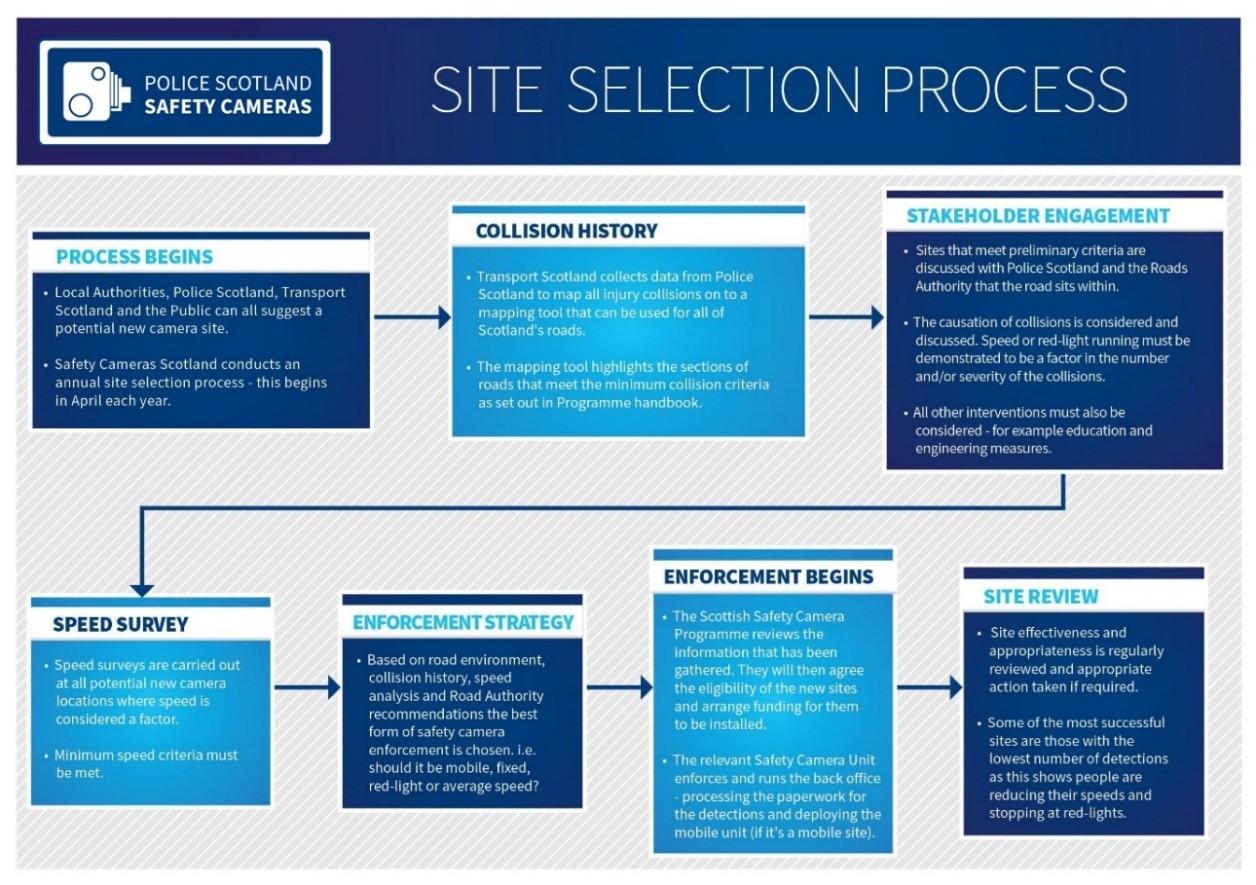
Police Scotland Safety Camera Site Selection Process
Sources
About — Police Scotland Safety Cameras
Scottish Safety Camera Programme: Handbook of Rules and Guidance 2022 https://www.transport.gov.scot/media/51339/scottish-safety-camera-programme-handbook.pdf
Department for Transport (2007) Using speed and red-light cameras for traffic enforcement: deployment, visibility and signing - GOV.UK
Agilysis (2018) Phase 2 Report: Reviewing and testing safety camera site selection criteria, Transport Scotland. transport-scotland-site-selection-criteria-report-phase-2.pdf